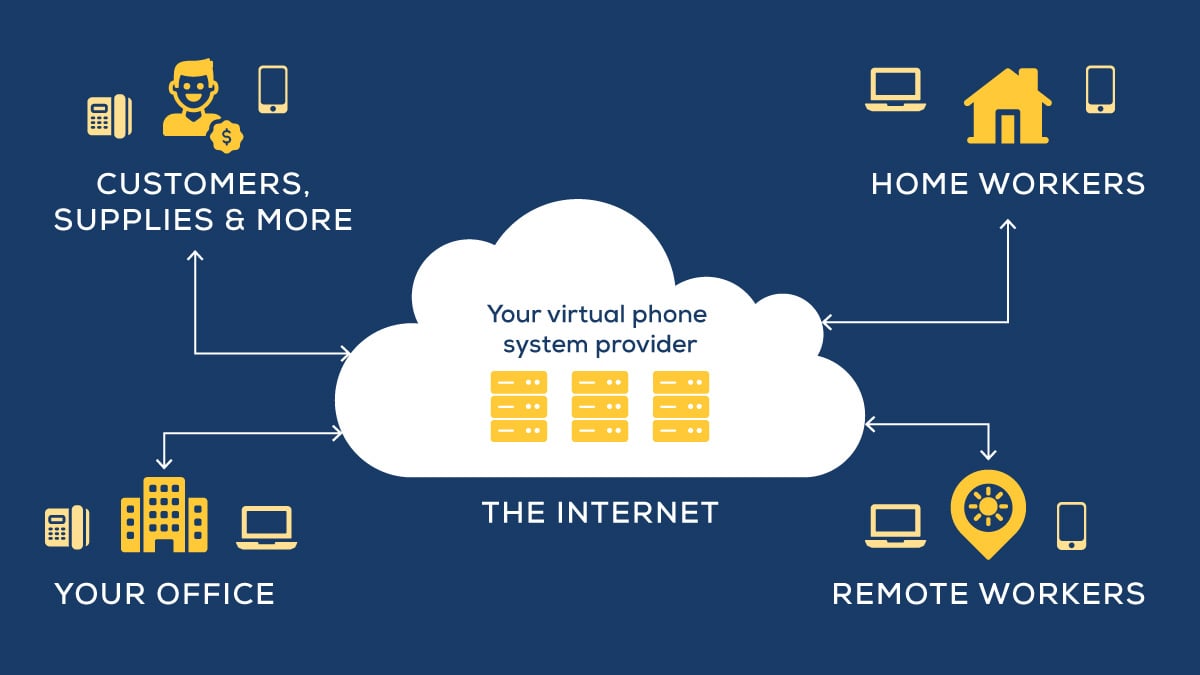
Relying on a single form of business communication is uncommon and, frankly, impractical. Your clients all have different communication preferences, and so do different departments and individual employees. What’s more, different communication tools have their own strengths and weaknesses.
Although your employees use multiple platforms to communicate, those platforms do not communicate with each other. That may sound like a tiny detail, but that tiny detail means that employees waste time searching across various tools for the information they need. At least, that’s what happens to organizations without a unified communications system, which consolidates different streams of communication into one platform.
Defining Unified Communications

Simply put, unified communications (UC) combines your business communication methods (voice, text, video, etc.) into a single system and allows conversations to move seamlessly from one device or method to another. It functions like a network or a set of interconnected networks.
That’s all well and good, but most businesses still underestimate the importance of streamlining their communications and the number of communication apps their employees have to keep track of each day. It’s… a lot.
What Tools Do Enterprise Unified Communications Solutions Replace?
Imagine if all of the tabs your staff have open for any of the solutions below were contained within one:
- Voice/conference calling
- Video conferencing
- Instant messaging/chat
- File sharing
- Collaboration workspaces
- Voicemail
- Faxing
- Presence/status indicators
- Calendar/scheduling
- Social media management
That list allows you to eliminate many tabs and probably a lot of overlap. But housing all of these tools in one place does a lot more than improve the employee experience. It can also dramatically improve the customer experience.
Why Is Streamlining Business Communication Important?

If you own a business, you’ve probably already felt this keenly: Customer expectations are evolving. But let’s take a closer look at what that means for businesses with these stats:
- 79% of customers expect consistent interactions across different departments within the same company, but 55% say that it doesn’t usually feel that way
- 56% of customers say they often have to repeat themselves to different representatives
- 86% of B2B customers say they’re more likely to buy from a company that demonstrates that it understands their goals
Let’s sum those stats up in another way. Disjointed experiences, inconsistent communication, information silos, and an inability for an individual company member to see the big picture when talking to a customer make an impression. It’s not a good one. And it could be costing your business real money.
Cloud-Based Unified Communications Platforms in Action

There are almost too many benefits of unified communications to count, but here are a few real-world scenarios that a unified communications tool can completely transform.
The Missed Call
If you are out of the office and a client calls, unified communications lets that call reach your cell, even if the client originally called your desk number. The call keeps ringing at your desk while your UC platform searches for your mobile over the network.
In seconds, a call can be rerouted to your mobile device or home line without your caller ever noticing. If left unanswered, the call routes back to your corporate voicemail, where the client can leave a message or reach additional support in your absence.
Oh… and that voicemail can be automatically translated into a text or email message so you can respond to it faster.
The Document Search
You know one of your coworkers shared a document with you, and you also had a good conversation — in writing — about how it needed to change. But it was a Monday morning, and you needed to attend to other things first. And now… where was that document shared? And where was that conversation? In the past, you might have searched through your inbox for a good 10 minutes. But thanks to your UC platform, it’s really easy to find every file and every conversation because even though the file was shared through an instant message, it doesn’t matter. It all goes to the same place.
Scenarios like those (and so many more) are just a few of the reasons why UC platforms have been able to demonstrate so much ROI over the past few years. But if you really want to make the most of these tools, you’ll probably want to buddy up with an expert.
The Benefits of Hosted Unified Communications vs. Going It Alone
Having one platform versus, say, 11 is a big deal. But it’s also a big deal when that one platform doesn’t work like it should.
You can absolutely invest in a UC platform yourself. But that means you’ll be doing all of the setup, management, maintenance, and troubleshooting that comes along with ownership. And when something goes wrong, your entire IT team will be scrambling. And while these platforms make it much easier than those old landlines did to implement a new system, add a user, or move locations, you need to keep in mind that “easier” doesn’t mean a person without sophisticated IT skills should be doing it.
Hosted UC is usually referred to as UCaaS — unified communications as a service. And like most SaaS solutions, you get to access powerful tools without a significant upfront investment. Plus, a good UCaaS provider can bring more to the table, like providing elite support and thorough end-user training so you can make the most of your investment.
Click the link below to learn more about our new (and improved!) UCaaS offering.