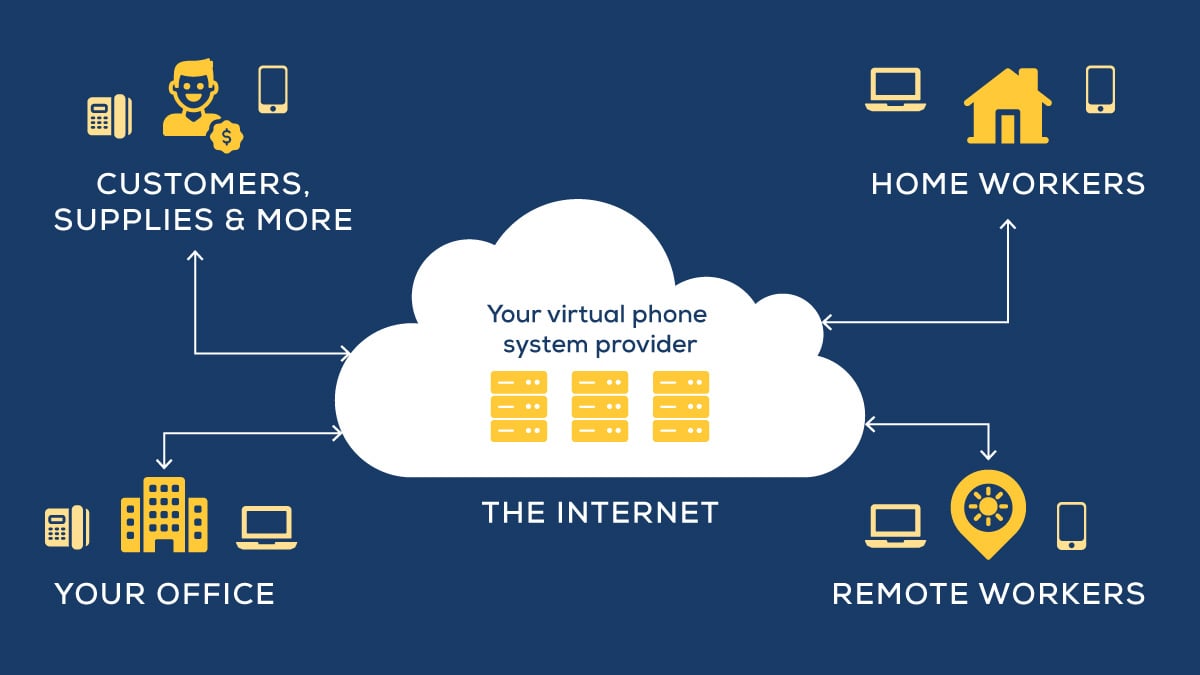
The short answer? If your business’s phone system is over 5–8 years old, it’s probably time to plan for an upgrade. If that seems short, look around the office at the age of the typical employee’s smartphone.
I get it — nobody wants to replace equipment that still technically works. But if your system is past its manufacturer's end-of-life date, your costs keep climbing, or your phones are limiting how your staff can work, it's probably time. If you’re on the fence, I’ll provide some specifics on when to prioritize an upgrade.
Signs your phone system has reached end of life
Most businesses don't wake up one day and decide to replace their phone system.
It happens gradually — a repair takes longer than it should, a part is back-ordered for months, a new hire can't get set up as fast as everyone else did. Here's what those moments usually add up to.
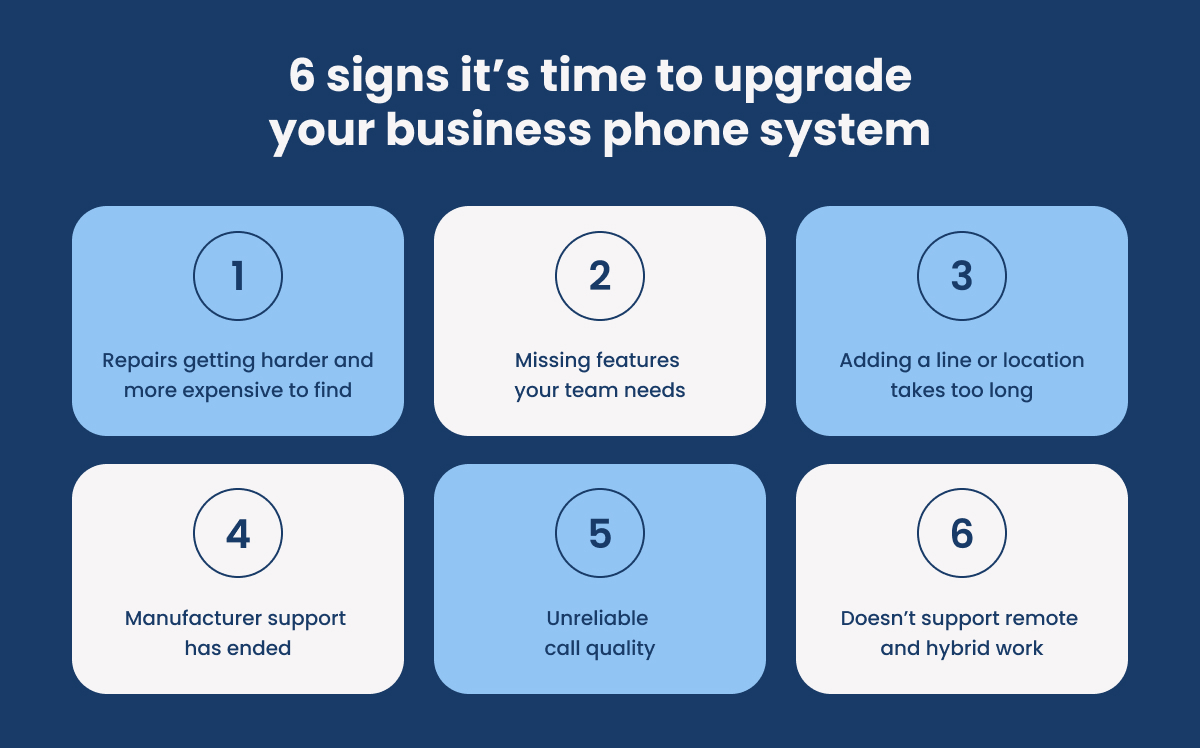
Repairs are getting harder
Once a manufacturer stops supporting a system, replacement parts get scarce, your configuration settings can get locked, and your technician spends more time hunting down a fix than making one — a pattern common to older phone systems.
You've lost features your team needs
Must-have features like voicemail-to-email, mobile apps, and auto-attendants are standard on modern systems. Legacy hardware can't add these, or newer ones like Talkative AI.
Adding a line or a location is a big project
If growth means a service call, a change order, and a delay, the system wasn't built to grow with you.
Technical support is ending
End-of-life systems don't get patched, and the vendor isn't obligated to help you anymore. That's a real problem when your phone system touches customer data.
Call quality is unreliable
Dropped calls, static, and one-sided conversations usually mean the hardware is overloaded or simply worn out.
Your system is dictating how your teams work
If your team can't take a call from a laptop or a mobile app, the phone system is working against how more and more people actually work now.
Bottom line:
If two or three of these problems I just outlined sound familiar, it's time to start planning for what's next — and systems rarely fail on a convenient schedule. Waiting until yours does usually means troubleshooting a shutdown while also hunting for parts and support that no longer exist.
What you gain by modernizing your legacy phone system
Businesses tend to focus on the cost of a new system, but fail to consider the cost (including staff hours) of their current one.
Cost savings
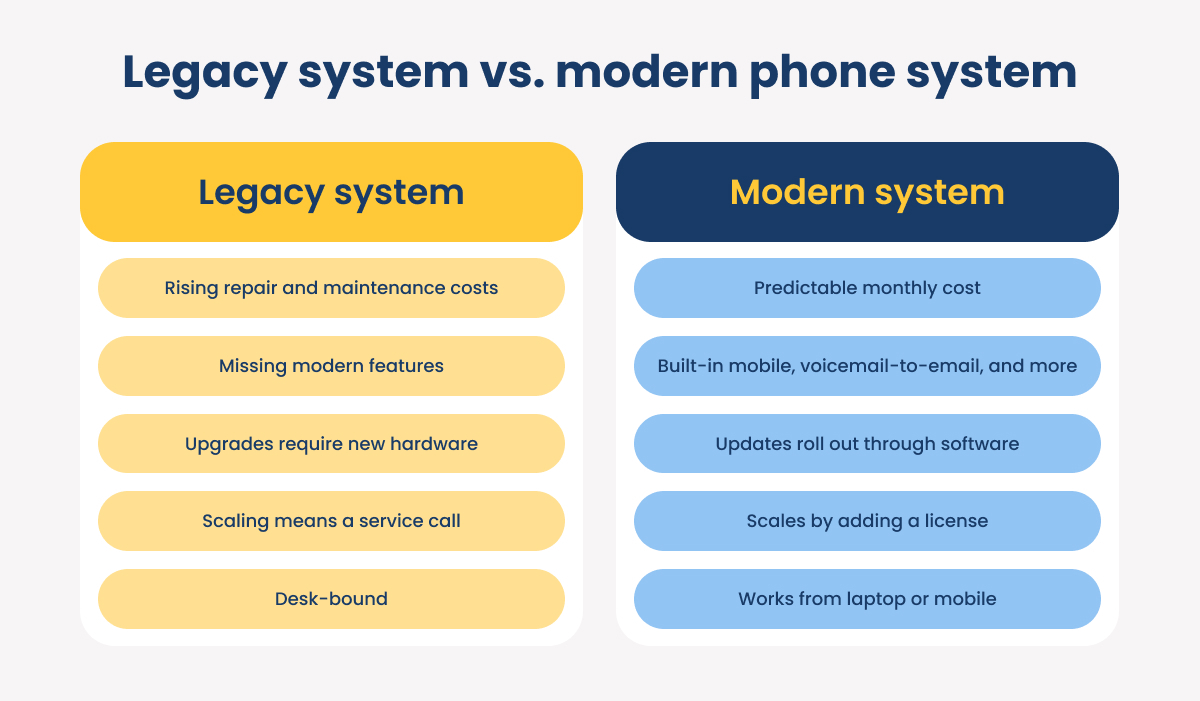
After the cost of the upgrade, savings are usually the first thing people notice — moving off a landline system can cut phone costs in half, since you're no longer paying for aging hardware, in-house maintenance, and per-line carrier fees.
Simpler updates
When you move to a cloud-based system, you’ll no longer have the same issues keeping up. A modern system runs on software, not a box that becomes obsolete the day a newer model ships. That means upgrades and new features roll out over time instead of forcing a full hardware replacement every several years.
Better functionality
A modern system can also give your team tools that actually keep up with them: calls that follow you to a laptop or phone, voicemail that lands in an inbox instead of a phone tree, and a system that scales by adding a license instead of scheduling a technician.
When it's fine to wait
Not every business needs to move today, and I'd rather tell you that than push an upgrade you don't need yet. If you invested in a system recently and it's still meeting your needs, there's no reason to abandon that investment early.
If you're on an aging on-premises system but still under warranty, it can make sense to run out that warranty period while exploring your options — including SIP trunking as a lower-cost interim step that modernizes your calling without a full system swap.
And if your team relies on a landline for reliability in an area where internet service is spotty, a cloud-based phone system is only as good as the connection under it — a new on-prem system may genuinely be the better fit.
What I'd caution against is waiting simply because switching feels like a hassle. If your system is already past end-of-life, every month you wait is a month closer to a failure that isn't on your schedule.
What to think through
Once you've decided it's time, a few questions shape what the right system looks like for your business, including whether you're comparing straight VoIP versus UCaaS.
- How old is your current system, and what's actually missing from it?
- How many users and locations need to be covered, including any remote staff?
- What's your growth plan for the next two to three years?
- Which features are must-haves — call recording, video conferencing, CRM integration?
- How reliable is your internet connection at each location?
- Are you still relying on fax lines or other analog equipment that needs to carry over?
-
Where are you in your current contract, and what's the real cost of waiting it out versus switching now?
Frequently asked questions
A few questions come up often enough that they're worth answering directly.
What counts as a legacy phone system?
Generally, any system running on hardware or software the manufacturer no longer updates or supports. If parts are hard to find or your provider can't patch it anymore, it's legacy.
How do I know if it's time to upgrade my phone system?
At Marco, we recommend replacing a phone system that’s over 5–8 years old. If you’re on the fence, the clearest signals that it’s time for an upgrade include:
- Rising costs
- Missing features your team needs
-
Support that's ended with your manufacturer
What are my options for replacing POTS lines?
Most businesses move to VoIP or hosted voice, while keeping a POTS line only where it's required for fax or fire alarm systems.
Is VoIP the same as a business phone system?
VoIP is the technology — a phone system is what runs on top of it. Most modern business phone systems today are built on VoIP.
Find out where you stand
One of the things that frequently gets in the way of an upgrade? A tough decision.
Phone systems have come a long way in a short time, and one of the side effects of that evolution is that there are multiple names for everything, and the ROI we’re already seeing from various systems has changed the guidance we’re offering.
That’s why my team put our heads together to come up with a simple quiz that would help point businesses in the right direction.
Not sure which system would be the best fit? It will walk you through the preliminary questions we typically ask and provide custom recommendations. Just takes a few minutes!