AI is showing up in the enterprise faster than most governance programs can keep pace with: forecasting models, customer service bots, code generation tools, decision-support systems, and more.
Every one of them makes a decision or shapes one, and most organizations have no consistent way to say who’s accountable when something goes wrong.
That gap is what an AI governance framework is built to close. It isn’t a single policy document or a one-time sign-off. It’s the ongoing structure that determines how a business builds, deploys, monitors, and takes responsibility for the AI it uses, whether that’s one chatbot pilot or a dozen models already in production.
What is an AI governance framework?
An AI governance framework is the set of policies, defined roles, and technical controls an organization uses to manage how AI systems are built, deployed, and monitored, and who's accountable for them.
It’s different from AI ethics, which sets principles, and different from AI risk management, which focuses narrowly on identifying and mitigating harm. Governance is the operating layer that makes both of those enforceable day-to-day, not a document that gets filed away after a launch review.
Three stages of AI governance maturity
Most organizations move through the same three stages on the way to a mature AI program:
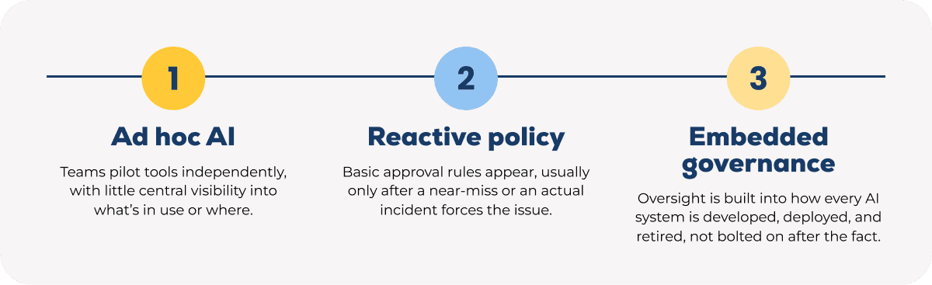
Trouble shows up when a business tries to operate at stage three, scaling AI across departments, while its governance is still stuck at stage one.
The four pillars of an AI governance framework
A workable governance program rests on four components. Skip one, and the others don’t hold up.
Risk classification
Not every AI use case carries the same stakes. Sort them by impact, low, medium, and high, and define plainly what’s allowed, what needs sign-off, and what’s off-limits. A chatbot drafting marketing copy doesn’t need the same scrutiny as a model screening loan applications.
Model accountability
Every model in production needs a named owner, someone tracking which version is live, where its training data came from, and what the model was actually built to do. Without an owner, no one notices when a model starts behaving differently than expected.
Monitoring and auditability
Log what your models decide so you can trace it later, and watch actively for drift, bias, and degrading performance. Finding a problem after it reaches a client is the expensive way to find out.
Human oversight
Define exactly when a person has to step in, and build a clear path for escalating failures and edge cases. High-stakes decisions shouldn’t be made by a model with no one watching.
What skipping governance actually costs
Put a governed organization next to an ungoverned one, and the contrast is stark:
|
No Governance in Place |
Governance in Place |
|
Decisions made by AI are essentially a black box |
Every decision can be traced and reviewed |
|
Models run without a clear owner |
Every model has documented accountability |
|
Compliance problems surface only after damage is done |
Risks get flagged and addressed ahead of time |
|
Behavior varies wildly between teams |
Consistent processes apply company-wide |
|
Employees use unapproved tools quietly |
AI tools are vetted and sanctioned centrally |
|
A single incident can damage the brand |
Response plans exist before a crisis hits |
That final row deserves extra attention. The fallout from an AI failure, a discriminatory screening tool, a fabricated customer answer, a regulatory violation, almost always costs more than the governance work it would have taken to prevent it.
A look at the vendor ecosystem
Beyond internal policy, a growing set of platforms now helps enforce governance in practice. A sampling of what’s out there:
- Compliance and GRC extensions — built by vendors with an existing footprint in privacy or risk management, extended to cover AI: inventorying systems, assessing vendor risk, and running approval workflows for legal and risk teams.
- Regulatory-mapping platforms — purpose-built for AI, focused on aligning systems with frameworks like the EU AI Act or NIST’s AI RMF, running structured risk assessments rather than repurposing a tool built for something else.
- Observability and monitoring tools — specialize in watching live model behavior: tracing how models perform in production, catching drift or anomalies, and surfacing issues before they reach end users.
- Lifecycle management platforms — aimed at large, heavily regulated organizations, managing AI systems from intake and validation through ongoing compliance reporting, at enterprise scale.
- Compliance automation platforms — originally built for broader security and regulatory compliance, now extending into AI-specific controls; a practical entry point for automating evidence collection across many frameworks at once.
Most of these tools specialize rather than cover everything, so companies with mature programs typically stitch together several rather than relying on one.
Picture governance as a pyramid
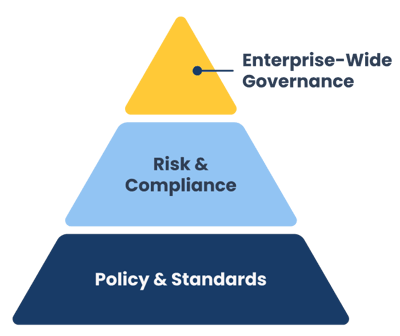 It helps to think of the whole discipline as three stacked layers:
- Policy and standards form the base. This is where every serious governance effort has to start: the acceptable-use rules and baseline standards everyone else builds on top of.
- Risk and compliance sit in the middle. This is also typically where momentum stalls, as good intentions sometimes collide with actual regulatory and legal complexity.
- Enterprise-wide governance sits at the peak. This is the layer that sets rules and obligations across the whole organization and, frustratingly, it’s usually the one nobody prioritizes until a problem forces the issue.
The shape of that pyramid tells you something important: skipping the base to chase the top does not work. Trying to bolt on enterprise controls before basic policy exists just means rebuilding everything later under pressure.
Practical first steps
A fully built program isn’t required to start reducing risk this quarter. A few places to begin:
- Build a registry that catalogs every AI tool and use case already in the organization, including the ones IT didn’t approve.
- Assign a named, accountable owner to every model in production.
- Draft a one-page policy defining what counts as acceptable AI use.
- Require a person to sign off before any high-stakes AI output goes live.
-
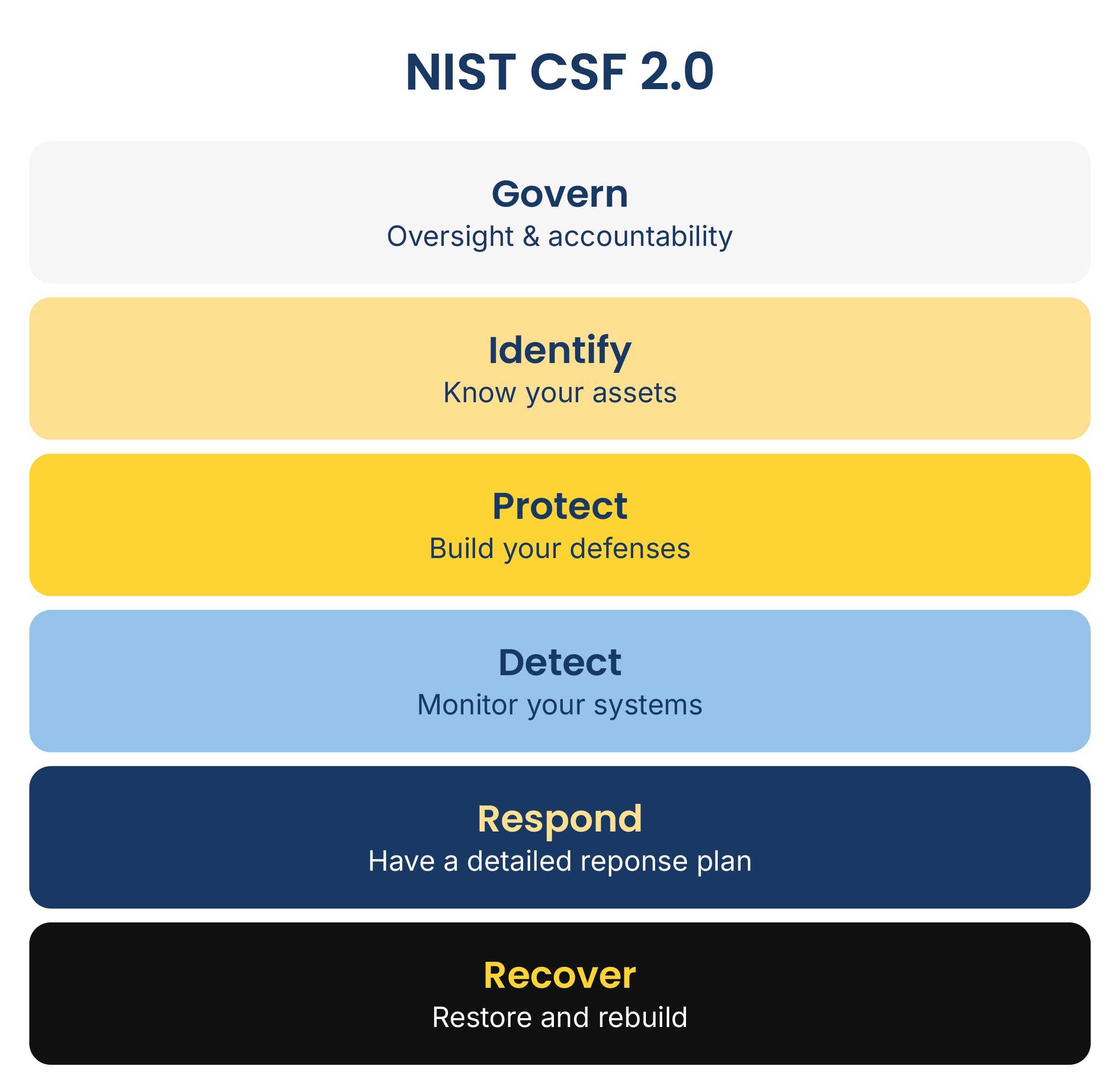
Anchor the program to a recognized standard — NIST’s AI Risk Management Framework is the most common starting point for U.S. businesses — and measure where current practices fall short.
Still in the piloting stage? Our guide on what to know before implementing AI tools walks through the decisions to make before a tool goes live at all.
AI governance FAQs
A few questions that come up often once this topic is on the table:
How is AI governance different from data governance?
Data governance protects information wherever it lives, including the AI tools it flows into. AI governance is narrower: it governs the AI systems themselves, who owns each model, how it’s monitored, and when a human has to step in. The two overlap and work best together.
Who should own AI governance at a mid-sized business?
Ideally, a cross-functional owner with visibility into IT, legal, and business operations, not IT alone. Many mid-sized organizations handle this with a fractional CISO who sets the policy and reporting cadence without a full-time hire.
Do smaller organizations really need a formal governance framework?
Yes, though the program should match the organization’s scale. A five-person marketing team piloting a chatbot needs a one-page policy and a named owner, not a governance committee. The four pillars still apply; they’re just sized down.
How is AI governance different from AI risk management?
Risk management is one piece of governance, the part focused on identifying and mitigating harm. Governance is broader: it also decides which AI use cases get approved in the first place, who holds decision rights, and what success looks like.
Start with a clear picture of your risk
Governance only works if an organization knows where its risk actually sits today, in its AI use and in the broader technology environment that AI runs on.
A Marco Cybersecurity Assessment gives you that starting point: a structured look at your current security posture, benchmarked against the NIST Cybersecurity Framework and CIS Critical Security Controls, with a clear set of priorities to act on.