It would be difficult to find an office where employees were still working on computers that couldn't connect to the Internet. Can you imagine trying to collaborate on documents without being able to store them in the cloud or going back to the days of the floppy disk? It's almost unthinkable!
Still, many businesses are scraping by on an on-site PBX system where half the devices don't have basic functions like a working speakerphone, and tasks like transferring a call or conferencing with a colleague are far more difficult than they should be. And if that sounds like your business, it's time to consider upgrading to a cloud-based phone system.
What Is Cloud Voice/Cloud-Based Telephony?

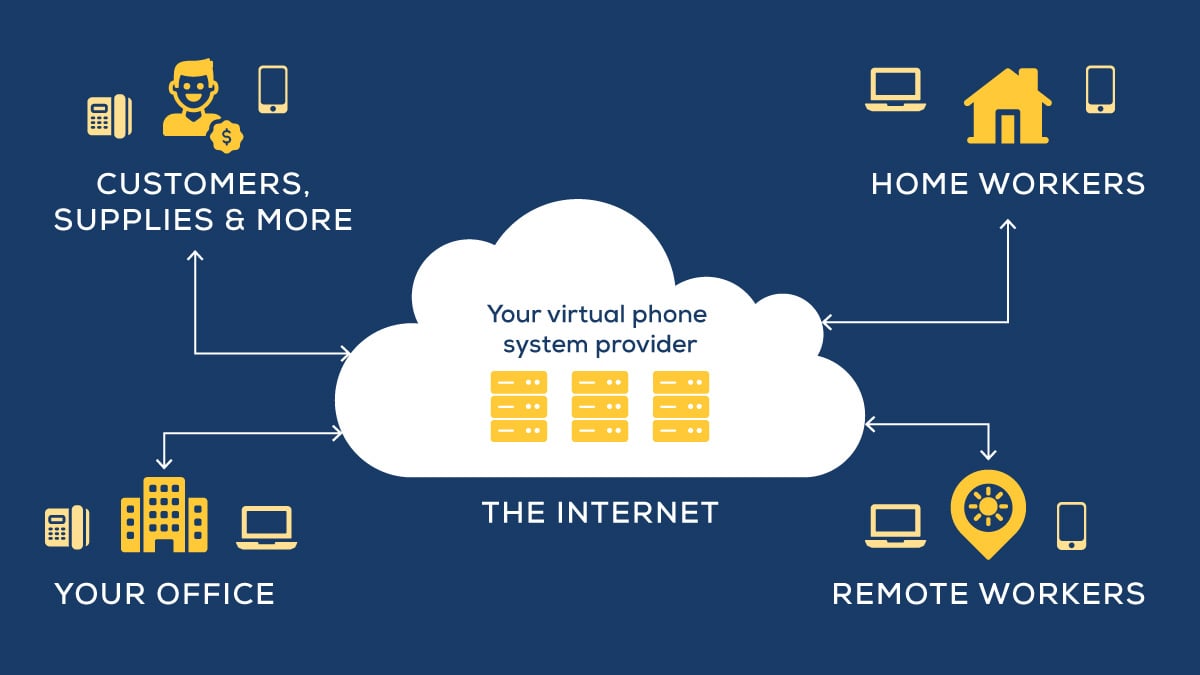
Cloud voice is a virtual phone system hosted in the cloud. It's also sometimes called cloud-based telephony, VoIP, hosted voice, or internet calling.
Why so many names? VoIP (voice over internet protocol) refers to the technology itself, and terms like hosted and cloud refer to how the service is provided. But you can feel free to use any of them, as they’ve come to be used interchangeably.
As the name might suggest, cloud voice doesn't require physical installation; it just requires an internet connection. And, as is the case with any online software platform, subscribers can access the latest communication features without having to constantly manage and update the technology themselves.
6 Benefits of a Hosted Business Phone System

If your phone system is over eight years old, it’s time for an update anyway. And if that update includes a move to cloud voice, it comes with a number of benefits that tend to make everyone around the office much happier.
1. Reduce On-Premise Hardware
When your communication technology lives in the cloud, there's very little hardware on-premise besides the physical phones and headsets used to communicate. Cloud-based communications are also easy for providers to manage and maintain since there's no need to send a technician on-site when or if problems occur.
2. Add Flexibility
Since it's internet-based, employees can now make calls from anywhere using the smart device of their choosing. Additionally, organizations can add or remove users and enable new features online, as needed.
3. Shift Communication From a Capital Expense to an Operating Expense
Cloud voice requires a regular, monthly investment, and all the extras like maintenance, patches, and upgrades are covered under your managed contract. You'll have a predictable monthly operating expense that makes balancing your budget and dealing with resource limitations simple. This replaces the old model of a single capital expense followed by unpredictable service and maintenance charges on an as-needed basis.
4. Save Money
Not only does cloud voice offer more predictable expenses, but it also offers significant savings. In fact, a business that makes the switch can expect to save 30–50%.
5. Keep Data Secure
I still get asked about whether or not cloud-based communications keep data secure. It’s a good question, and I’m always happy to give an honest answer. The cloud is actually one of the safest places to store your data, and providers understand that providing top-notch security is non-negotiable.
Nothing is fool-proof or 100% risk-free, but 94% of businesses saw an improvement in security after switching to cloud communication tools. That’s because security features like call encryption and 24/7 network monitoring are typically included.
6. Get Seamless Implementation
The final benefit I'll share with you is the simplicity of implementation. Of course, that depends on the provider you choose, but our hosted voice service includes taking stock of your existing phones and communication technology, determining the bandwidth requirements for your organization's needs, providing end-user training, and setting up the devices and the software. And after setup, you have access to high-quality customer service if and when you need it.
The Challenges of Switching to Internet Calling

The pros will outweigh the cons for most businesses that are making the switch to internet-based calling.
However, here are a few challenges that sometimes require more time and thought than companies plan for:
- Making sure staff are familiar with and comfortable with any new equipment before it’s live
- Taking stock of all of the lines and numbers you’ll need, including toll-free and fax numbers
- Any unique phone needs for certain individuals or departments
- Making sure your internet can handle the demand without sacrificing call quality
That last point can still be a struggle for some regions, so while switching to cloud voice is often a no-brainer, it’s not always that simple. Still, if you can overcome the challenges I outlined above, you probably should move forward, and soon.
Why Not Just Scrape by on Landlines?
Your landline phones are already obsolete, and at some point, upgrading to cloud voice will be necessary. That said, many businesses have weathered a significant amount of change in the past few years, and it might be a tough time to think about making another one.
You can put this one off…for now. But the longer you do, the longer you’ll be paying for out-of-date and inflexible technology. If you have access to reliable internet, it’s probably best to upgrade as soon as possible. Then, when many organizations are forced to scramble, you won’t have to be one of them.
Finding the Best Small Business Phone System
You have a wide variety of options when it comes to choosing a cloud-based phone system. That’s the good news. The bad news — it can be hard to research your options online, because a lot of outdated information is still out there.
Once you decide moving to a hosted voice system is the right move, your next task will be picking the type of platform that will bring you the most ROI. Not that long ago, a phone specialist would have advised most small businesses to go with a fairly basic cloud voice system, perhaps with a few must-have features like hot desking or mobile twinning. However, unified communications has had a few years now to prove its worth, and the numbers are nothing to shake a stick at.
Take a look at our complete (and up-to-date) guide to hosted voice solutions to decide which options make the most sense!