First off, I just want to say that I’ve never met a business owner who was happy about having to comply with regulations. Meeting compliance can require time and money, often from organizations that have a scarcity of both. And if that weren’t enough, regulations aren’t static. They change, and they can be difficult to interpret, and they can be especially tough on the little guy.
However, in my field, regulations are designed to protect an individual’s safety and privacy. And if your experience is like most Americans, for the rest of your life, you will be fighting off hackers who got your Social Security number off the dark web because just one company was shockingly irresponsible with the data it collected. That’s not okay. So in this blog, I’ll provide some clarity about cybersecurity compliance and what various industries need to know.
What is cybersecurity compliance?
Cybersecurity compliance means following the rules and standards set by governments and industry groups to keep your business and your clients safe from cyberattacks. These rules help protect your company's digital information and computer systems from hackers who might try to steal, damage, or disrupt your data.
The specific protections you need will depend on what kind of data you handle and the industry you’re in. However, requirements are designed to protect your systems and data against:
- Malicious access or use
- Unauthorized disclosure
- Disruption
- Destruction
- Unauthorized modification
A simplified cybersecurity compliance framework

I speak for most cybersecurity professionals when I say that cybersecurity compliance isn’t just about checking a box. These regulations outline what you should be doing to protect your organization from a cybersecurity attack that could be far more devastating than a fine. Remaining compliant is in your own best interests, every way you look at it.
But because regulations can contain vague language, here’s a simplified list of what effective cybersecurity compliance should look like in your organization:
1. You’re following the rules
You’re complying with any cybersecurity laws and regulations you need to follow for your industry and your location.
2. You’re meeting the standards of your industry
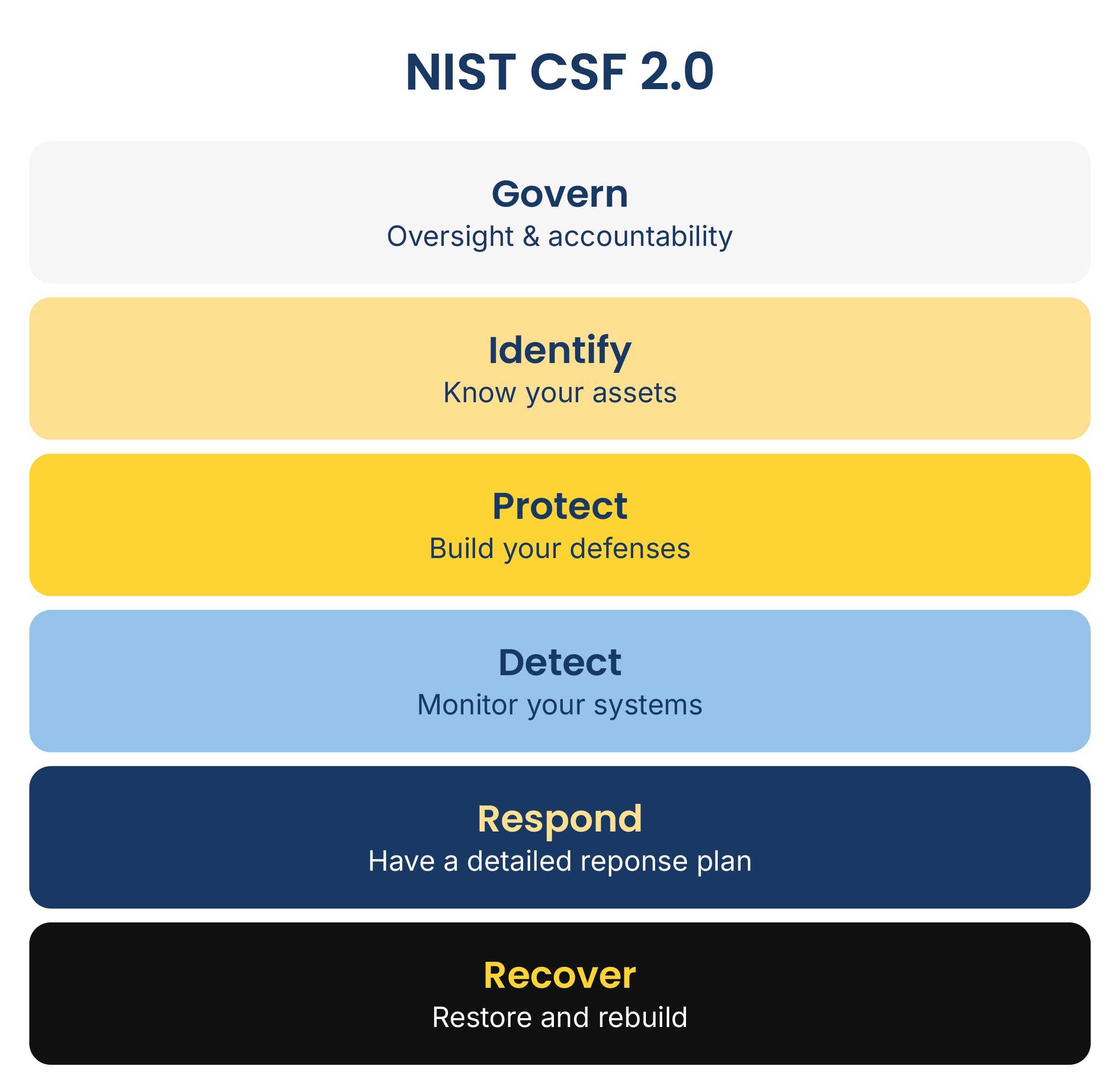
Beyond legal requirements, there are proven frameworks like ISO 27001, the NIST Cybersecurity Framework (CSF), and the Center for Internet Security (CIS) that provide clear roadmaps for strong security.
3. You have clear policies that are known and enforced
Every regulated organization should have written policies and procedures that spell out how your team should handle data and security, as well as a way to make sure these policies and procedures are followed.
4. You’re managing risk effectively
While no security solution is a 100% guarantee, you’ve taken steps to control who can access sensitive data and when, to protect your data when it’s at rest and in transit, and to regularly reassess your vulnerabilities as threats to your industry evolve.
5. You have a plan for worst-case scenarios
You have a clear incident response plan (IRP) and a business continuity plan (BCP) that are reviewed at least annually, and whenever relevant roles, processes, and tools change.
6. Your staff is trained to spot threats
You provide regular, engaging security awareness training to your employees so they can help you protect your organization from phishing and malware attacks.
7. Your systems are monitored continuously
You’re confident that your current monitoring and auditing solutions will alert you if there are any signs of unauthorized access, so you can mount an effective response quickly.
8. You keep detailed records
Your current solutions make it easy to quickly gather the data you’d need in case of an audit.
If all of the above sounds like your organization, then at least at a glance, you appear to be in good shape.
More specific cybersecurity compliance standards by industry

Because every industry faces different threats, compliance standards aren't always the same.
Healthcare
Healthcare organizations must protect patient health information when sharing it between doctors, hospitals, and insurance companies. HIPAA sets the rules for how this sensitive data can be handled and transmitted.
Understanding HIPAA requirements
HIPAA (the Health Insurance Portability and Accountability Act) requires healthcare organizations and their business associates to protect patient health information through administrative, physical, and technical safeguards. The standard covers everything from encryption to secure payment systems, and the requirements are designed to keep your business and your patients safe.
CURRENT HIPAA enforcement
Healthcare organizations are facing a perfect storm of new HIPAA challenges in 2025. With ransomware attacks up 264% last year, the Office for Civil Rights (OCR) is cracking down hard on data security, including the launch of a new Risk Analysis Initiative specifically targeting organizations that skip proper security risk assessments or just go through the motions with superficial reviews.
Meanwhile, the Department of Health and Human Services has proposed major updates to the HIPAA Security Rule that would require things like multi-factor authentication, encryption, and regular penetration testing. As I've been saying throughout this blog, these are what any cybersecurity professional would recommend anyway. Still, smaller healthcare organizations that have fallen behind may soon see increased pressure on an already tight budget.
upcoming changes
Patient access continues to be a hot-button enforcement issue, and the OCR has had to settle multiple cases for organizations that didn't provide timely record access. Many of these enforcement actions started with just one patient complaint, which illustrates how a single incident can expose widespread compliance problems and lead to significant penalties.
The intersection of AI and healthcare data is also creating new compliance headaches. While HHS hasn't issued AI-specific HIPAA requirements yet, I'd advise healthcare organizations to be especially careful about third-party AI tools and tracking technologies that might inadvertently access protected health information. There's also ongoing legal drama around reproductive health privacy rules, with Texas challenging the new protections in federal court.
Legal
Law firms are required by state bar ethics rules to maintain reasonable security measures and implement data breach notification procedures. Beyond those baseline requirements, legal organizations must ensure that cybersecurity failures don't expose privileged client information or create malpractice liability.
Confidential client data, legal strategies, and case files are protected by attorney-client privilege — but only if they're handled with appropriate security controls. A breach that exposes attorney-client communications can destroy privilege and trigger legal liability. This means encryption, access controls, and backup procedures need to be ironclad.
Many law firms also work with clients in regulated industries (healthcare, financial, government). Your security posture directly affects your clients' compliance status, making your infrastructure a shared responsibility.
Financial services
If you process credit card payments, your business needs to follow the Payment Card Industry Data Security Standard (PCI DSS), which requires encrypting card numbers and secure payment systems.
And if you offer financing, your organization must follow the Standards for Safeguarding Customer Information as outlined by the FTC. That may come as news to quite a few car dealerships, colleges and universities, and mortgage lenders.
But, once again, the requirements are designed to keep your business and your customers safe, and are exactly what any cybersecurity professional would recommend for an organization that stores a high volume of sensitive financial data — multifactor authentication (MFA), penetration testing, and regular vulnerability assessments, as well as the monitoring and logging solutions.
Manufacturing
Manufacturing facilities operate at the intersection of IT and operational technology (OT), where cybersecurity directly impacts production continuity and uptime. A successful cyberattack on your manufacturing environment can stop production, disrupt supply chains, and create significant liability.
If you're part of the defense industrial base or work with the Department of Defense, CMMC 2.0 (Cybersecurity Maturity Model Certification) is going to start being enforced in November, 2026.
Beyond CMMC 2.0, manufacturers face increasing requirements to implement strong security across both IT and OT networks, conduct regular security assessments specific to production systems, and maintain continuous monitoring. For many manufacturers, a managed security partnership is more cost-effective than building these capabilities in-house.
How to measure your cybersecurity posture
The compliance landscape is changing faster than most organizations can keep up with. But compliance is just one part of a larger security picture.
In just a few minutes, our cyber health quiz gives you a baseline on your overall security posture — where gaps exist, and what matters most for your business. It takes a few minutes and gives you actionable insight into your current level of risk.