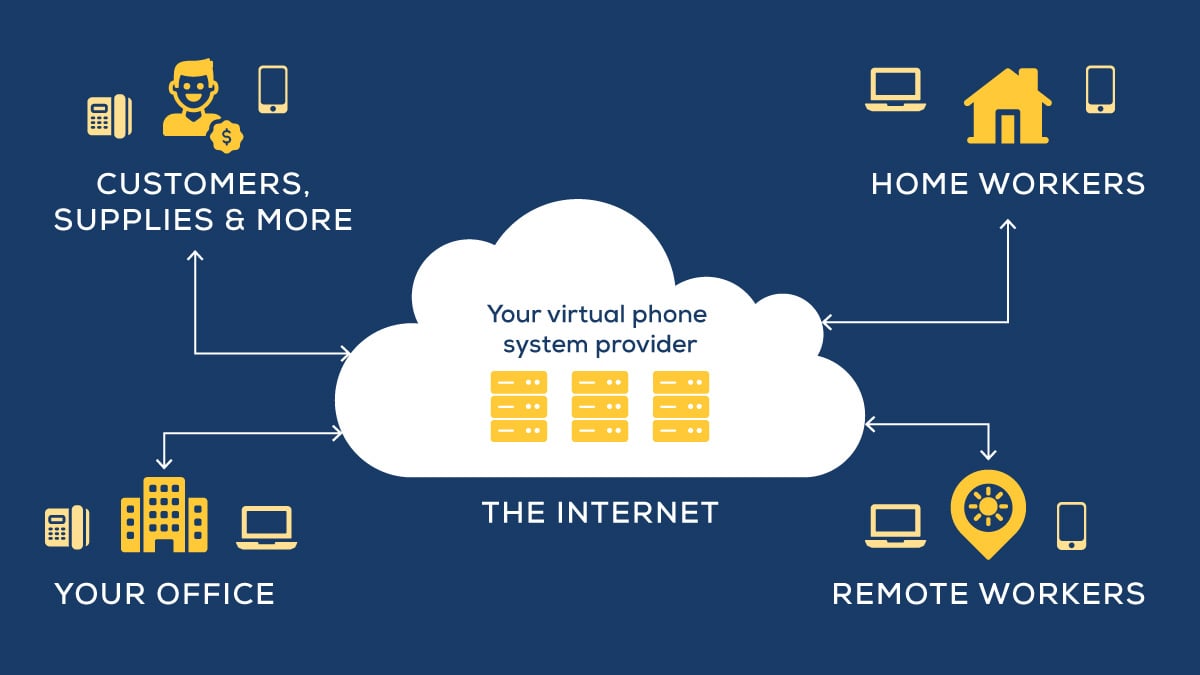
Back in early 2020, there were a lot of predictions that the pandemic would be a great unifying force. In many ways, it has proven to be just the opposite. But in the technology space, the pandemic has spurred us to come up with amazing innovations to ensure that human beings can connect from just about anywhere. Businesses are now able to accommodate collaboration on any number of projects in real time whether their employees are in different areas of the city, or different parts of the world. It may not feel like it, but in many respects, we are better communicators than we ever have been.
The recent rush to innovate has produced two competing modes of communication: Cloud Voice or Unified Communication as a Service (UCaaS). Both enable voice communication via the internet, and have their unique advantages as well as disadvantages. Neither one is inherently better than the other, and the right solution for you depends on a variety of considerations.
Simplicity vs. Flexibility

If you're looking for a simpler, cost-effective communications system, Cloud Voice, or Voice Over Internet Protocol (VoIP) is probably the better choice. Cloud voice gives you a more basic rate plan with a single carrier, and can accommodate web portal management, voicemail to email, call distribution and more. Cloud Voice is frequently an excellent choice for small or home-based businesses.
On the other hand, UCaaS is a feature-rich system that's often best for larger organizations that are accustomed to regularly using a wide variety of communication tools. With UCaaS, employees can use telephones, email, voicemail, conference calling, instant messaging, web conferencing, video conferencing, desktop sharing and mobile integration, all within the same communications system. Furthermore, UCaaS is customizable, and offers full reporting and analytics. In short, UCaaS provides a feature-rich, single system for all communication methods in your business, but it can be more complicated in terms of setup and pricing.
In-Person vs. Remote Staff
Both Cloud Voice and UCaaS work from the cloud. But UCaaS allows employees to use its full suite of communications tools on any smart device, while reducing the cost of equipment and maintenance. Prior to the pandemic, younger generations of workers already indicated a strong preference for communications tools that enable real-time collaboration on the go. And as coronavirus continues to transition from pandemic to endemic, many companies still have fully remote workers, or are contemplating a longer-term hybrid model. However, if your office is likely to remain entirely in-person, UCaaS, with its additional complexities, may not be warranted.
Consumption vs. Flat Rate
Both Cloud Voice and UCaaS can provide significant savings over analog phone systems. They can also save your IT staff precious time when they're not maintaining obsolete and overly complicated equipment for each individual employee.
However, while Cloud Voice frequently comes with flat rate plans, UCaaS is a consumption-based service. Flat rate plans are obviously easier to budget for, but additional features may be limited by your existing hardware and support services. With UCaaS any existing feature is available, as long as you have the budget to pay for it.
Enhanced Security vs. Internet Dependence
Both VoIP and UCaaS offer enhanced security over traditional analog phones. If you're considering adding either of these services, it's important to talk to your provider about encryption, authentication, firewalls, and other capabilities that may be necessary to safeguard employee and client data. However, both VoIP and UCaaS require high speed internet to function reliably; during service disruptions, it’s important to note that access to emergency services could be limited.
Ultimately, switching to Cloud Voice or UCaaS tends to offer businesses far more for less money. And while it’s a complicated topic, there's no need for you to spend hours researching the two. Our experts are happy to answer any questions you might have in clear, straightforward language.