Managed IT services typically include the management of every tool and system in a workplace’s tech stack. Back in the day, most tools and systems needed in-person support. But now that more and more work is done using cloud tools, remote troubleshooting by a managed IT provider is often just as fast — if not faster — than having an on-site team.
That said, if quick troubleshooting is all you’re getting from a managed IT provider, that’s a pretty low bar. So in this blog, I’ll explore what’s usually included in managed IT services, and what you should know if you’re in the market.
What Do Most Managed IT Service Providers Include?
Not all managed service providers (MSPs) offer the same services, use the same tools, or work in the same way.
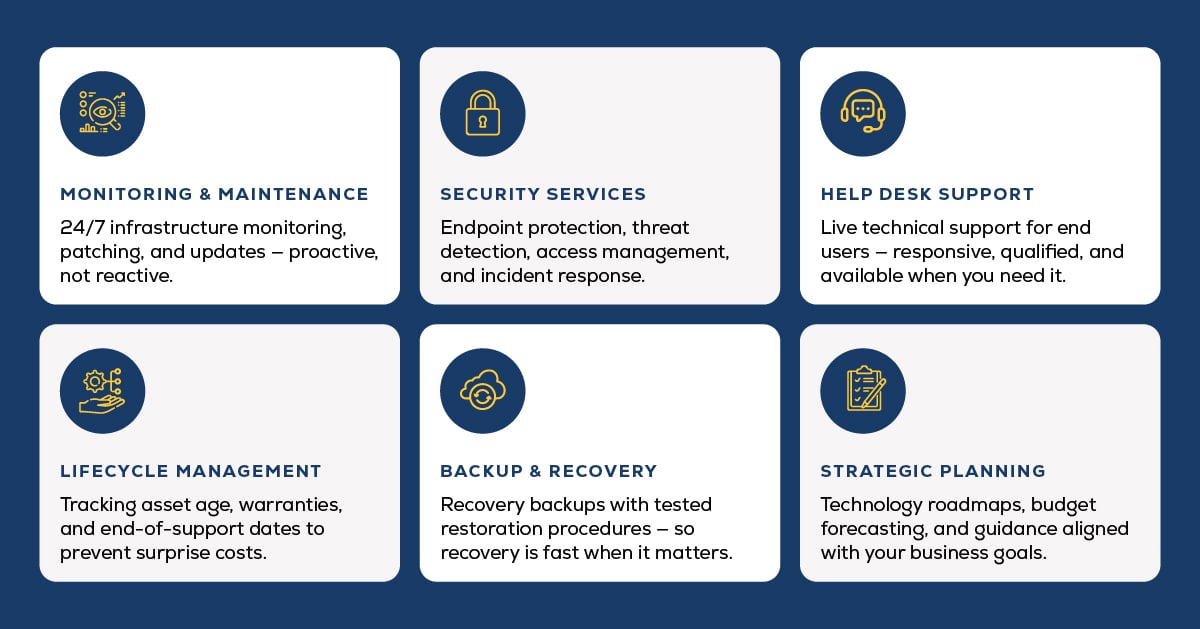
A top IT provider will typically provide these services:
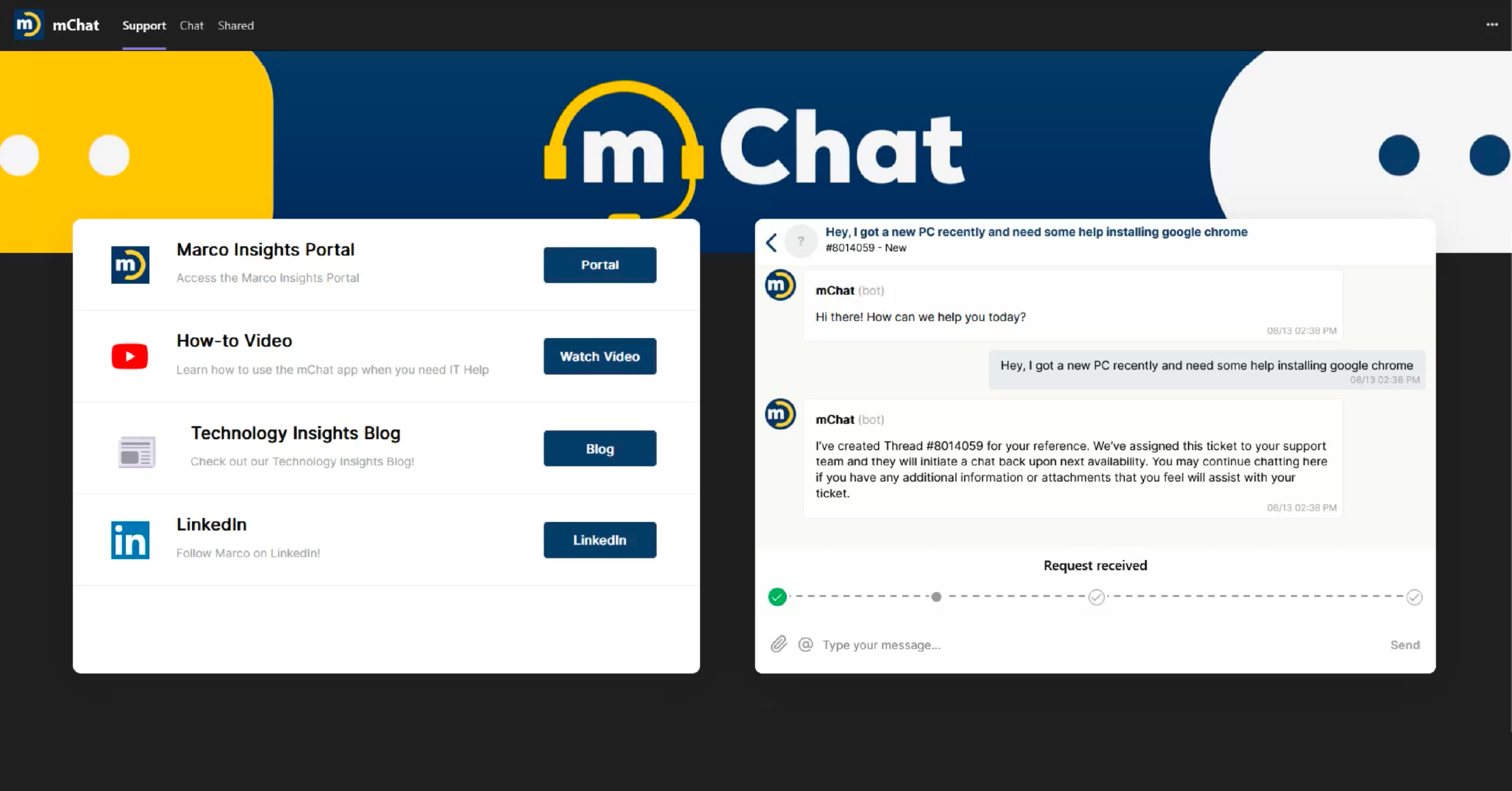
- Unlimited Support Desk
- On-site escalation support
- Remote network reviews
- Network operations center
At Marco, we also add regular client business reviews, where we sit down with leadership and talk through their goals and how we can best support them. We also talk through how their tools and equipment are performing, as well as our own responsiveness. Essentially, we don’t want to act like vendors. We want to be strategic business partners.
Here are the tools a top IT provider will bring to the table:
- Threat detection and response
- Secure managed network
- Remote 24/7 systems management and monitoring
- Security training, including phishing
- Email and web security
- Anti-malware protection
That said, not all threat detection and response tools provide the same protection. At Marco, we’re constantly adjusting our strategic partnerships to serve our clients better.
What’s Not Typically Included in Fully Managed IT Services?

While managed IT services cover the core infrastructure that keeps your business running, it's important to understand what typically falls outside the scope of a standard service level agreement (SLA).
Strategic IT Consulting
Your managed services provider handles the day-to-day operations, but decisions like "Should we move our entire infrastructure to the cloud?" or "What ERP system should we implement?" may require dedicated consulting time, business analysis, and strategic planning beyond routine management.
At Marco, we have more of these kinds of conversations during our client business reviews for IT clients, and we also offer them for non-managed IT clients, either as ongoing IT consulting services or through one-off technology assessments.
Custom Software Projects
Custom app development will be outside the scope of a managed IT contract. Building custom tools, developing proprietary applications, or creating integrations between complex business systems requires project-based work with defined scopes, timelines, and deliverables.
That said, at Marco, we’re currently in the process of adding new automation services, where our teams will work with clients to identify opportunities for automation and then design and deploy solutions through Microsoft’s platform.
Hardware Purchases
Depending on your SLA, hardware purchases will often be billed separately from your monthly managed services fee. Believe it or not, it’s often better that way. You’re free to purchase solutions from another vendor, and you don’t have to wonder whether or not your IT provider is only recommending equipment updates so that they can make more money.
End-User Training for Specialized Software
When we implement a new complex system for a client, we provide end-user training. We do it for printers, phone systems, document management systems, and more. But teaching your sales team how to use a new CRM, for example, would typically be out of scope.
Telecommunications Services
Telecommunication services, like internet circuits, phone systems, and cellular plans, are usually procured directly or through specialized vendors. Your managed services provider may help you select and implement these services, but the ongoing bills typically come from the telecom providers themselves.
It’s always a good idea to know your provider’s SLA like the back of your hand before you sign, so there are no surprises down the road. And if you see something you don’t like, say something! A lot of buyers don’t know this, but SLAs are negotiable! If you want to add on a service, you can always ask.
Large-Scale IT Projects
Cloud migrations, data center relocations, or infrastructure overhauls require dedicated project teams, extensive planning, and defined timelines. Your managed services provider may be able to execute these projects, but expect them to be quoted and managed separately from your ongoing monthly support.
Advanced Managed IT Security Services
This can be a tricky one! While a managed IT team should be able to handle basic security hygiene — antivirus, patch management, firewall configuration — cybersecurity is becoming a specialized skill.
Depending on who you partner with, here’s what often falls outside of a provider’s scope and capabilities:
- 24/7 Security Operations Center (SOC) monitoring
- Threat hunting
- Penetration testing
- Security audits
- Compliance assessments (HIPAA, PCI-DSS, SOC 2)
Many businesses assume comprehensive security is "included," only to discover their IT provider doesn't have the staff, certifications, or tools to deliver enterprise-grade security monitoring and incident response. If your industry has strict compliance requirements or you handle sensitive data, you may need a Managed Security Service Provider (MSSP) in addition to — or integrated with — your managed IT services.
After-Hours Emergency Services
Depending on how your IT provider prices their services, you may find that they offer a great monthly rate, but any after-hours emergencies are billed separately, and at a much higher rate.
Here’s the problem with that — when an IT provider makes a profit when you experience an emergency, what’s their incentive to prevent one? IT emergencies can get very expensive very quickly, which is why at Marco, we’d rather be proactive and give our clients smooth sailing. And yes, that sometimes means we aren’t the cheapest bid. But when it comes to managed IT, you do tend to get exactly what you pay for. And a top provider may be able to find you more long-term financial savings that more than make up for the cost difference.
How To Find the Best Managed IT Support in Two Questions

If you’re in the market for a managed IT provider, you’re likely to hear a lot of sales pitches about excellent service and best-in-class support. But if you want to save yourself some time, here’s what you need to ask.
1. Do You Have a SOC 2 Type 2 Report?
A SOC 2 Type 2 report means that an independent auditor has verified that this provider is consistently following best practices, including providing the necessary cybersecurity protection to safeguard an organization’s data.
2. How Much Money Could You Save Me?
Many top IT providers will cost a bit more, but could help you save more over time. In fact, in many cases, managed IT services can help pay for themselves. At Marco, our strategic partnerships with top equipment manufacturers and software developers allow us to offer best-in-class pricing for our clients. From there, we are often able to help clients eliminate overlapping tools and other IT overhead costs.
My team is always happy to run the numbers for a prospective client to give them a better sense of the overall ROI they’d be getting.
FAQs About Managed IT Solutions
Managed IT is a complicated topic! Here are some of the questions we get most often.
Q: Is Managed IT worth it for small businesses?
A: It depends. If your provider offers per-user pricing, that often makes managed IT services the more affordable choice, even for a small business.
Q: What should I do if I’m having doubts about my current IT provider?
A: Get a second opinion. Many IT providers will offer one-time technology assessments. It’s not unusual for an organization to use these to get a check-up on its current provider.
Q: How can I get out of my managed IT contract?
A: Ask another provider. At Marco, we’re happy to look into your service level agreement to see if we can provide you with an easy out. If your provider isn’t living up to their promises, we can advise you on how to frame that conversation. But even if your provider is living up to their end of the bargain, if they’re reputable, they probably won’t want to keep an unhappy client.
Q: How quickly is Marco’s IT team able to respond to clients?
A: At Marco, 96% of calls to our support desk are answered within ten seconds, and 98% of issues can be resolved remotely.
Q: Is Marco a reliable IT provider?
A: Yes. Marco has achieved a SOC 2 Type 2, which means that an independent auditor has found that we’re consistently following best practices for our clients.
Want to get a quick estimate of what managed IT services would cost? Click the link below!