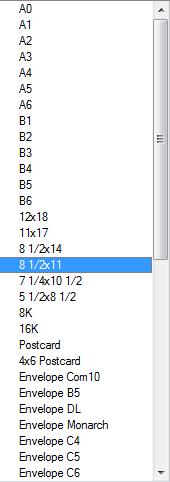
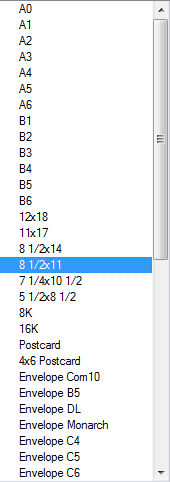
 A multifunction printer is designed to handle a wide variety of paper sizes but can vary by manufacturer and model. These options open up many possibilities for companies that want to keep printed projects in-house. This is especially beneficial for unique printing projects, like posters or marketing materials, but also includes advantages for day-to-day printing as well.
If you are like most users you stick to using the same standard paper sizes when you print – letter, legal and tabloid. This is most likely out of habit and partly because you are unfamiliar with the other options. We’ll start this blog by covering the most common paper sizes and end by introducing the many additional sizes your printer may be capable of handling.
Most Common Paper Sizes
Here are the standard sizes used in most business environments in North America:
- Letter: 8.5" x 11" – ANSI A*
Standard for business and academic documents. - Tabloid:17" x 11" – ANSI B*
Ledger: 11" x 17" – ANSI B* - Legal: 8.5" x 14"
- Junior Legal: 8" x 5"
- 12 x 18 – Arch B*
Because we are talking about common paper sizes most multifunction printers can handle, it is also important to mention envelope sizes. The most common size used in businesses is the number 10 envelope. This is because it holds a Letter size paper folded three times and Legal paper size folded four times. However, as with paper sizes, there are many envelope size options available. There are many types of envelopes, including commercial, announcement, catalog, booklet, baronial and square, and each has its own size variety. We intend to cover this topic in more depth in a future blog so please sign up to be notified when blogs are published.
*Additional North American Paper Sizes
Although perhaps not considered standard in most business environments, we would like to make you aware of some additional North American paper sizes.
In 1995 the American National Standards Institute (ANSI) defined a scale for standardizing paper sizes. Two of the most commonly used paper sizes, letter and tabloid, fall into this scale.
- ANSI A: 8.5" x 11" – Letter
- ANSI B: 11" x 17" – Ledger/Tabloid
- ANSI C: 17" x 22"
- ANSI D: 22" x 34"
- ANSI E: 34" x 44"
Additionally, North America has a special series for architectural purposes which are based on 4:3 or 3:2 ratios, which are similar to that of computer screen sizes. Again, these sizes aren’t used often for standard printing purposes, but your multifunction device may give you some of these options.
- Arch A: 9" x 12"
- Arch B: 12" x 18"
- Arch C: 18" x 24"
- Arch D: 24" x 36"
- Arch E: 36" x 48"
- Arch E1: 30" x 42"
ISO Standard Paper Sizes You May Find Useful
Beyond North America, ISO standard paper sizes are used most often and considered standard. Unfortunately there is no simple conversion between these different standards. The ISO standard has 3 series – A, B and C. Within each series the paper size is named with the letter of the series followed by a number; as that number increases, the paper size decreases. The A series, the most popular was developed first; then the B series was developed to extend the range of paper sizes. Finally, the C series are envelope sizes that coordinate with A series paper sizes.
All ISO standard paper sizes have an aspect ratio equaling the square root of 2. This is convenient because it makes enlarging or reducing documents for different sized paper extremely simple. Here are the paper sizes (in inches, but are commonly measured in millimeters) and some of their most common applications.
A Series:
- A0: 33.1" x 46.8"
Technical Drawings/Posters - A1: 23.4" x 33.1"
Technical Drawings/Posters; Flip Charts - A2: 16.5" x 23.4"
Flip Charts; Drawings/Diagrams/Large Tables - A3: 11.7" x 16.5"
Drawings/Diagrams/Large Tables; Newspapers - A4: 8.3" x 11.7"
Letters, magazines, forms, catalogs, laser printer and copying machine output
Comparable to the North American Letter size. - A5: 5.8" x 8.3"
Note pads; Books - A6: 4.1" x 5.8"
Post cards; Books - A7: 2.9" x 4.1"
- A8: 2.0" x 2.9"
Playing cards - A9: 1.5" x 2.0"
- A10: 1.0" x 1.5"
B Series:
- B0: 39.4" x 55.7"
- B1: 27.8" x 39.4"
- B2: 19.7" x 27.8"
- B3: 13.9" x 19.7"
- B4: 9.8" x 13.9"
- B5: 6.9" x 9.8"
Books - B6: 4.9" x 6.9"
Books - B7: 3.5" x 4.9"
- B8: 2.4" x 3.5"
- B9: 1.7" x 2.4"
- B10: 1.2" x 1.7"
C Series:
- C0: 36.1" x 51.1"
- C1: 25.5" x 36.1"
- C2: 18.0" x 25.5"
- C3: 12.8" x 18.0"
- C4: 9.0" x 12.8"
Envelope for A4 letters - unfolded - C5: 6.4" x 9.0"
Envelope for A4 letters – folded once - C6: 4.5" x 6.4"
Envelope for A4 letters – folded twice - C7: 3.2" x 4.5"
- C8: 2.2" x 3.2"
- C9: 1.6" x 2.2"
- C10: 1.1" x 1.6"
Although you may not have need for many of these paper and envelope sizes, we hope we’ve helped you understand the extent of the sizes available and how they could enhance or extend your printing options.
Most likely, your multifunction printer can handle many more options than you are familiar with; please check your manual, your manufacturer’s website or ask a print provider for the paper size options available for your printer.
Receive more print-related information just like this, as well as additional instructions on how to get the most out of your multifunction printer, or fleet of printers, by signing up for our blog..