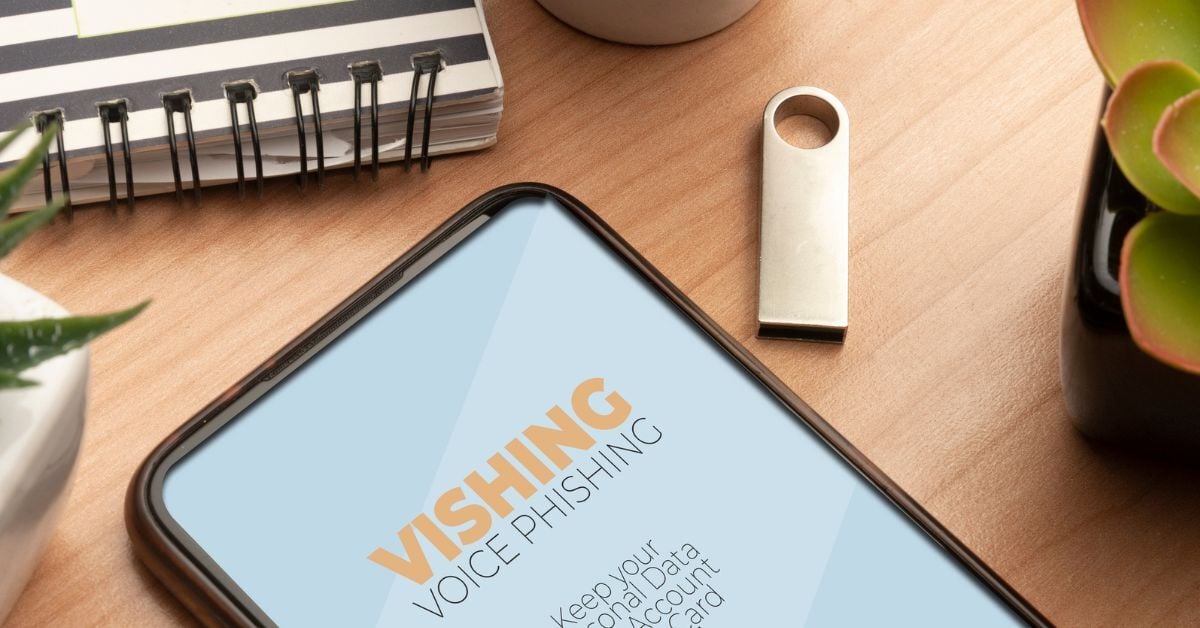
Vishing is short for “voice phishing.” Like other forms of phishing attacks — including email and text-based scams — the goal is to trick someone into handing over credentials, financial data, or access to systems.
Vishing attacks are unfortunately common and difficult to recognize unless you know what you’re looking for, so in this blog, I’ll provide examples, plus how to protect your business.
A Simple Vishing Definition
Vishing is a type of phone scam in which cybercriminals call targets and use deception, urgency, or impersonation to extract sensitive information. What makes vishing unique is the medium: a phone call, which carries a built-in sense of immediacy and personal authority that email can't replicate.
Attackers may use real human callers, pre-recorded robocall messages, or increasingly, AI-generated voices that are difficult to distinguish from the real thing. They'll often pair a call with a text message beforehand — establishing credibility before the voice contact begins.
Vishing vs. Phishing: What's the Difference?
Phishing happens primarily over email. The attacker sends a message designed to look like it's from a legitimate source, and the recipient is prompted to click a link, open an attachment, or reply with sensitive information. These attacks work far too often because our brains are wired to respond to certain psychological triggers — and attackers know exactly which ones to pull.
Vishing uses a phone call instead of an email. The real-time nature of a voice conversation creates different psychological pressure — it's harder to pause and fact-check when someone is speaking to you directly, especially if they sound authoritative or urgent.
What About Smishing?
Smishing is another subcategory of phishing that uses SMS text messages as the entry point.
All three can work together. A common multi-step attack might begin with a spoofed text, followed by a vishing call that references it, making the whole interaction feel more credible.
Common Types of Vishing Attacks

Cybercriminals don't use a one-size-fits-all approach. Here are the most frequently used methods, so you can get a sense of what to listen for:
Government Agency Impersonation
Callers will often claim to be from the IRS, Social Security Administration, or another federal agency. The message typically involves a threat — unpaid taxes, a compromised benefits account, a pending legal action — designed to create panic and get the target moving before they stop to think.
Bank or Financial Institution Fraud Calls
Someone contacts you claiming there's suspicious activity on your account. They walk you through "verifying" your identity, which usually means reading back your account number, PIN, or authentication code.
Fake Tech Support
The caller says your device has been flagged for a security issue. They'll ask for remote access to "fix it" — or request payment through unconventional means like gift cards or wire transfers.
Business Impersonation and Invoice Fraud
A caller pretends to be from a vendor your company works with. They reference a real invoice that's "overdue" or request an updated payment account number. This type of attack often starts with publicly available business information — or in some cases, documents pulled from a company's trash.
Internal Impersonation
This is where vishing intersects with business email compromise (BEC). An attacker researches an organization, then calls IT or finance pretending to be an employee — armed with enough real information to sound legitimate and request account access or a funds transfer.
MGM Resorts learned this the hard way when a hacker impersonated an employee, called IT support, and used publicly available information to convince them to reset multi-factor authentication credentials. The breach ultimately cost MGM more than $52 million in lost revenue.
Voicemail Phishing
The attacker leaves an urgent voicemail asking the recipient to call back a spoofed number. When they do, the conversation is already set up to manipulate them.
Pro tip: Vishing is also frequently used as one piece of a larger operation. These multi-channel social engineering campaigns can unfold over days or weeks before a voice call ever happens — by which point the target already trusts the interaction.
How AI Is Changing Vishing Attacks
Vishing is not the same threat it was even two years ago. Attackers now have access to voice-cloning tools that can replicate a real person's voice from a short audio sample. That means a call could appear to come from your CEO, your bank's representative, or a trusted colleague — and sound convincingly like them.
Caller ID spoofing technology has also become widely accessible, allowing attackers to display any number they choose — including your organization's main line, a local area code, or a federal agency. What you see on your screen tells you less and less about who's actually calling. AI is accelerating this across every attack surface, not just voice — which is part of what makes staying current on the threat landscape so important.
7 Ways To Prevent Vishing Attacks

Protecting your organization starts with knowing what to look for — and building habits that hold even under pressure.
1. Treat Any Unsolicited Call as Unverified
Even if the caller ID matches a trusted organization, that information can be faked. If something feels off, hang up and call the organization directly using a number from their official website.
2. Never Act on Urgency Alone
Vishing attacks are built around pressure. Any caller who demands immediate action — especially involving money or account credentials — should be treated as a red flag, not a deadline.
3. Establish a Verification Process for Financial Requests
Require two-person approval for wire transfers, invoice changes, or vendor payment updates. One phone call should never be enough authorization.
4. Don't Confirm Sensitive Information With Inbound Callers
Even if the caller already seems to know details about you or your business, that information may have been gathered in advance. Familiarity is not the same as legitimacy.
5. Use Multi-Factor Authentication (MFA)
MFA doesn't prevent a vishing call, but it limits what an attacker can do even if they DO obtain a password.
6. Register With the National Do Not Call Registry
Registering won't stop criminal activity, but it reduces the overall volume of unsolicited calls — which makes genuine scam attempts easier to spot.
7. Shred Documents That Contain Vendor or Business Information
Low-tech information gathering is still common. Confidential documents in the trash can give an attacker enough detail to build a convincing impersonation.
That’s why we recommend shredding any documents containing data about your business partners, customers, financial data, or anything else that could be used by a scammer.
Not sure where your organization's vulnerabilities actually are? A cybersecurity assessment is a practical starting point for understanding your exposure before an attacker finds it first.
The Role of Employee Training in Vishing Prevention
Policies and technology help — but the person picking up the phone is still your first line of defense. Vishing specifically targets human behavior: trust, authority, fear, and urgency. And no firewall catches a conversation.
Your security awareness training program should include vishing-specific scenarios. Many employees know to be skeptical of suspicious emails, but fewer have practiced recognizing a high-pressure phone call in real time. And attackers know it. A broader security strategy — one that covers how data is governed, accessed, and protected across your organization — is what makes training stick long-term.
Frequently Asked Questions About Vishing
Vishing isn’t new, but attackers are changing their tactics frequently. Here are up-to-date answers for common questions.
What does vishing stand for?
Vishing stands for "voice phishing." The "v" replaces the "ph" from phishing to indicate that the attack is carried out over a voice call rather than email.
How do I know if I'm being vished?
Common warning signs include calls you didn't initiate, requests for urgent action, pressure to share account information or make a payment, and callers who become aggressive if you ask to verify their identity. Legitimate organizations will not penalize you for hanging up and calling back through a verified number.
How can businesses prevent vishing attacks?
A combination of employee training, call verification protocols, multi-factor authentication, and two-person approval for financial transactions provides the strongest defense. Training employees to recognize social engineering tactics — not just email-based ones — is particularly important.
What are common signs of a vishing call?
Several red flags can signal a vishing attempt: The call is unsolicited, the caller creates urgency or threatens consequences for inaction, they ask for sensitive information like passwords or account numbers, they resist giving you time to verify their identity independently, or they request unusual payment methods like gift cards or wire transfers.
Remember — legitimate organizations rarely demand immediate action over the phone. And they'll never penalize you for hanging up and calling back through a verified number.
How To Prevent Vishing Attacks From Succeeding
Vishing is one tactic in a scammer’s playbook — and it works precisely because it targets people, not systems. The organizations that hold up best under these kinds of attacks are the ones where security awareness is treated as an ongoing practice, not a one-time checkbox.
That means training that's relevant, scenario-based, and engaging enough that employees actually retain it. It also means leadership that models the behavior — because if executives bypass verification protocols or wave off security policies as inconvenient, the rest of the organization will too. Security culture has to come from the top.
If you're ready to build that kind of culture at your organization, we can help — from user training to the security infrastructure that supports it.