Sometimes we human beings need that extra push. Most of the technology necessary to accommodate remote work was available years ago, and workers had been asking for more flexibility for quite some time. It took a global pandemic for remote and hybrid work environments to become commonplace. And once they did, a stream of new and promising apps immediately flooded the market, each one offering different combinations of features.
No matter which set of tools and apps an organization adopted, there was one almost universal problem: each app, by itself, was designed to boost collaboration and productivity. But using too many actually drained both. The more apps you add, the easier it is to miss messages or spend too much time tracking information coming through multiple channels. Finally, toggling endlessly between apps and having to master eight different platforms can be overwhelming and stressful.Reducing the number of extraneous and overlapping communication apps your team is using is great. But if you can get it down to one, it's even better. And that’s exactly what Unified Communications is all about.

What Is Unified Communications?
Unified Communications (UC) refers to phone systems that do more than facilitate voice calls. With UC, you can also send text messages, chat, make video calls, and manage your calendar through a single app.
Benefits Of Unified Communications
Unified Communications is one of those technologies that makes everything just a little bit easier, so its advantages are difficult to sum up in one or two sentences. It shaves precious time off the things employees do hundreds of times a day, and all of those minutes really add up. Studies indicate that UCaaS leads to improved productivity for 72% of users, better collaboration for 91%, and faster problem solving for 88%.
Some of the most popular features of Unified Communications are the following:
- You'll be able to quickly respond to customer requests through chat and text
- Team and Group messaging allows you to collaborate easier, and avoid long email threads
- Interactive voice response lets customers navigate your directory using voice commands, reducing the need for a full-time receptionist
- Integrate your calendar and share your screen to simplify planning and collaboration during virtual meetings
- With Presence, you can see which coworkers are available without having to ask
- Contact Center integrates email and texting into one integrated app to enhance a call center's abilities
- You'll be able to integrate valuable analytics, call recording and customer relationship management (CRM) tools
What Is Unified Communications As A Service?
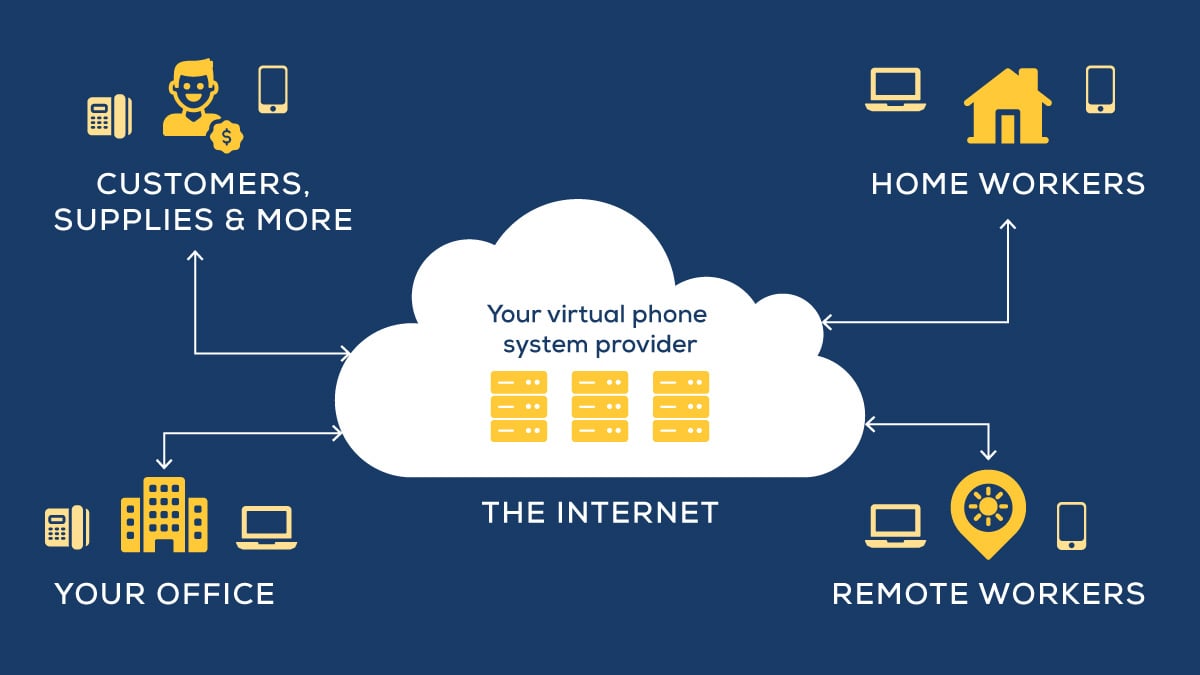
Hosted Unified Communications, or Unified Communications as a Service (UCaaS) is simply Unified Communications provided by a third-party vendor, which is typically delivered over the internet. UCaaS tends to save organizations a significant amount of money and provides better availability, flexibility, and scalability. For example, with UCaaS, you'll never be tied to your desk during a call. Any call can be automatically transferred to your preferred smart device as you walk out the door. UCaaS simplifies many challenges of remote or hybrid work environments, and makes business travel far more productive.
Finding The Right UCaaS Provider
UCaaS is meant to simplify your life, not to make it harder. A good UCaaS provider should be responsive and should get to know your organization so they can help you assess which features you really need, and which ones you don't. And just like the providers of any other service, their pricing should be straightforward, and so should their communication with you.
At Marco, our UCaaS services use Mitel hardware and software; they’re the industry leader in providing custom communications solutions, and have won back-to-back awards for empowering remote work. Additionally, our service technicians are also Mitel Certified, so if you ever need help, they'll be there.
If you're wondering if UCaaS might be a good fit for your organization, we've created this handy guide to simplify your decision-making. You're also welcome to schedule a conversation with one of our communication specialists at a time that's convenient for you.