For most businesses, the inkjet vs. laser printer decision comes down to two numbers: how much you print and what each page actually costs you.
Laser printers cost more upfront, but they get cheaper per page as print volumes go up. Inkjet printers cost less to buy and often produce richer color, making them the better fit for lower-volume or graphics-heavy work. But a lot of businesses are somewhere in the middle, so we’ll provide more specifics to help you choose.
What's the difference between inkjet and laser printers?
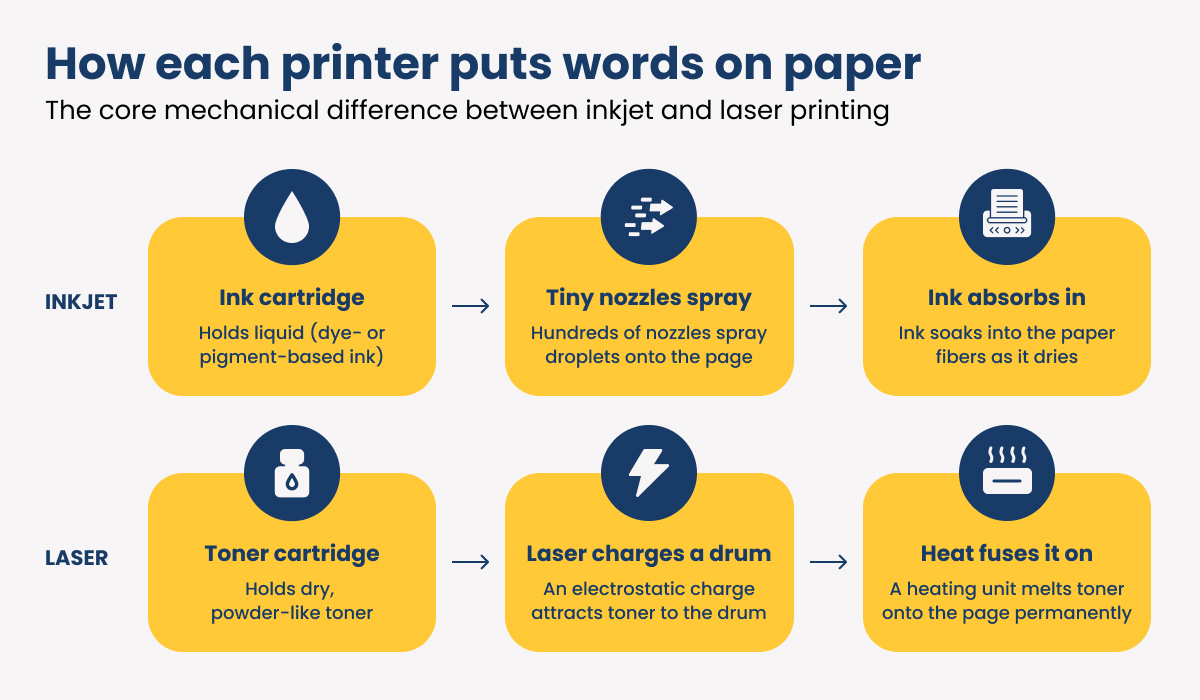
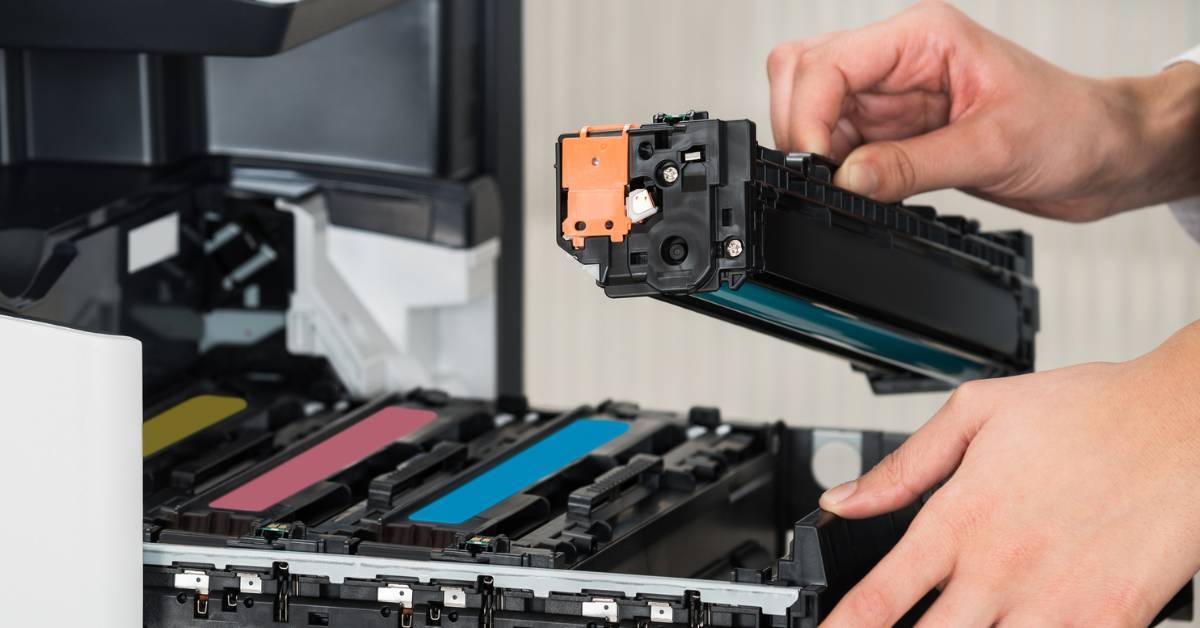
Inkjet printers spray microscopic droplets of liquid ink directly onto the page. Laser printers use a laser to charge a drum, which attracts powdered toner that's then fused to the page with heat.
That mechanical difference drives almost every practical difference between the two: cost per page, speed, maintenance, and how each holds up under daily use.
Do laser printers use ink?
No. Laser printers use toner, a fine powder fused to the page with heat, rather than the liquid ink used in inkjet printers. That's also why laser printers don't dry out the way an idle inkjet can.
Which costs less, inkjet or laser?
Upfront price tells you almost nothing about what a printer actually costs your business. Cost per page is the number that matters once you're past the first few months.
Inkjet cost profile:
- Lower upfront hardware cost
- Higher cost per page, particularly for color and photo-quality printing
-
Total cost climbs fastest for offices that print often
Laser cost profile:
- Higher upfront hardware cost
- Lower cost per page at volume, because toner cartridges print far more pages per cartridge than ink
-
The cost advantage grows the more your office prints
Takeaway: Inkjet is cheaper to buy. Laser is cheaper to run. Your print volumes will decide which one is the more cost-efficient.
Which printer produces better print quality?
Inkjet and laser take very different approaches to putting an image on the page, and the difference shows up when you compare the two side by side.
Inkjet quality:
- Richer color gradients and finer photo detail
-
A strong fit for marketing materials, proofs, and presentations printed in-house
Laser quality:
- Sharper, more consistent text
-
The standard for high-volume documents like contracts, invoices, and reports
Takeaway: Inkjet wins on color and photo detail; laser wins on crisp, consistent text at volume, though the real black-and-white vs. color printing decision often matters more than the printer type itself.
Which printer needs less upkeep?
Ink and toner age differently, and that shows up as downtime if you don't plan for it — often as recurring common printer problems.
- Ink can dry out in the printhead if a device sits unused for stretches, which is common with seasonal or backup printers
- Toner has a longer shelf life and doesn't degrade the same way sitting in a supply closet
-
Laser printers generally have fewer moving parts prone to jamming under heavy daily use
Takeaway: Toner sits idle better than ink. If your printer goes weeks without heavy use, laser is the safer bet.
Which printer handles more paper types?
Paper handling is another area where the two diverge, particularly across different printer paper sizes.
- Inkjet printers offer more flexibility across paper types, including glossy and specialty stock
- Laser printers handle standard business paper reliably at higher weights and volumes
Takeaway: Inkjet flexes across paper types; laser sticks to standard stock but handles it reliably at volume.
Which printer’s faster?
Speed and duty cycle — the number of pages a printer is built to handle in a month — matter more than most buyers realize until they've bought the wrong machine.
- Laser printers process multi-page jobs faster because toner fuses to paper faster than ink dries at volume
- Laser printers are built for higher monthly duty cycles, which matters for a device shared across a team
-
Inkjet printers can bottleneck a busy office, especially on long print runs or shared multifunction devices
Takeaway: If your office shares one printer across a team, laser keeps up. Inkjet can become the bottleneck.
What should you think through before buying?
A consumer buying guide stops at ink versus toner. A business decision has to be weighed differently:
Print volume by department
An office-wide average can hide where your real print volume comes from. For example, an accounting team running invoices and monthly statements prints at a completely different scale than your sales team printing the occasional color proposal.
Look at volume by department before you commit to one printer type.
Multifunction and network needs
Scanning, faxing, and secure print release matter more as your team grows, and a single desktop printer rarely keeps up. Most growing offices shift from local printers tied to one desk to networked printers that multiple departments can access and manage centrally.
Fleet security
Every printer on your network is a potential entry point, not just a desk accessory. Unique device passwords, secure decommissioning when a device is retired, and a print security assessment protect the data moving through every machine on your network, not just the ones handling sensitive documents.
Supply chain reliability
A device that goes down for a week over one missing part costs more than the part itself.
In fact, that’s exactly why our new Logistics Center exists — to keep replacement parts and supplies moving with two-day shipping nationwide, so a shortage doesn't turn into a week of downtime.
Which is better for a small business, inkjet or laser?
Business size matters less here than how your team actually prints day-to-day. Use these as a starting point, then weigh them against your real print volume.
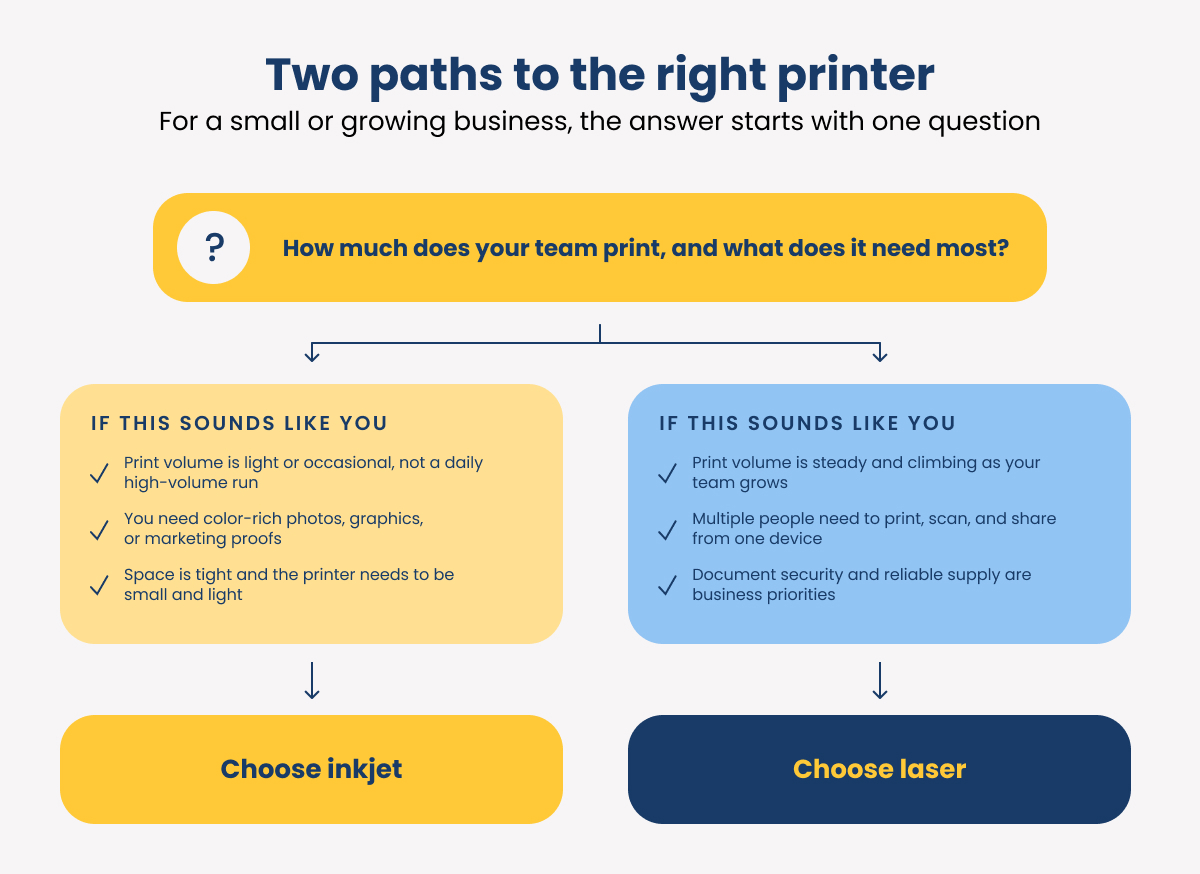
Choose inkjet if:
- Your office prints under a few hundred pages a month
- Color quality and photo detail matter more than raw speed
- You need a compact device for a small or shared workspace
-
Your print jobs are mostly short documents, not long runs
Choose laser if:
- Your office prints several hundred to several thousand pages a month
- Text documents make up most of what you print
- Multiple people share one device throughout the day
-
Cost per page matters more to you than upfront price
If you’re falling somewhere in the middle, you’re always welcome to set up a free consultation with a print expert here at Marco. No pressure!
Frequently asked questions
A few questions come up more than the rest when businesses compare inkjet and laser.
What's the difference between an inkjet and a laser printer?
Inkjet printers spray liquid ink onto the page, while laser printers fuse powdered toner using heat. That difference drives nearly every other distinction between the two, from cost per page to print speed.
Is an inkjet or laser printer better?
Neither wins outright — it depends on volume and document type. Laser is the better fit for high-volume text printing; inkjet holds the edge for color and photo-quality work at lower volumes.
If you’d like custom recommendations for your business, take Marco’s free 2-minute printer quiz.
Which is cheaper, inkjet or laser?
Inkjet is cheaper to buy. Laser is cheaper to run. For offices that print regularly, toner's lower cost per page usually wins out over time.
What's the cost per page difference between inkjet and laser printers?
Toner cartridges cost more upfront than ink but print far more pages per cartridge, which is why laser's cost per page comes in lower at moderate to high print volumes.
Do laser printers dry out?
No. Toner is a powder, not a liquid, so it doesn't dry out the way ink can in a printer that sits unused for weeks at a time.
The fastest way to find the right printer
Believe it or not, unmanaged printing costs are often a business’s third-highest expense, after rent and payroll.
Some of those costs come down to using the wrong printer for the job.
Researching printers usually isn’t on anyone’s list of favorite activities, so our print team put their heads together to draft a simple, 2-minute quiz. Answer a few questions about your business and how you print, and get custom recommendations to save you time.