Ahh, your trusty telecommunications bill. You can count on these to arrive every month, without fail. What do you typically do when your telecom services bill arrives?
If you’re like most businesses, you open it, pay it, and move on with your day. Do you take any extra time to review it or make sure it matches your contract? You might take a moment to make sure the amount is roughly the same as last month – but that’s only if you have a second to spare.
If this sounds like your process, you are likely overpaying for your telecom services. Here’s a quick and easy example I come across far too often:
Let's say you get charged 3.5 cents per minute for 800 number calls. In your first month, you used 1,000 minutes, and you got charged $39.
Wait a minute… at 3.5 cents, that should only be $35.
This time it's only $4 – but it can add up very quickly over time. I encourage you to look a little closer the next time your telecom bill arrives.
“But, I Can’t Read It Anyway”
Now, this I completely understand; learning the items listed on your bill might feel like learning a new language.
All telecom carriers bill their customers differently. Some break the bill down line-by-line, others simply list the lump sum you owe. Each will name their products and services something different, and they all have different names for their phone line packages - which you’ll never remember what they actually mean.
Despite this, learning to recognize some of the most common errors on your telecom services bills is pretty easy, if you know where to look.
Before You Start, You Need to Know…
What you sign on your contract is not what will appear on your bill. You should expect your bill to be higher, because it will include taxes, regulatory fees, usage charges, and surcharges, which typically aren’t outlined in the initial proposal from the telecom carrier. You might, for example, sign a contract and expect to pay $531 a month, but your first bill comes in at $664.
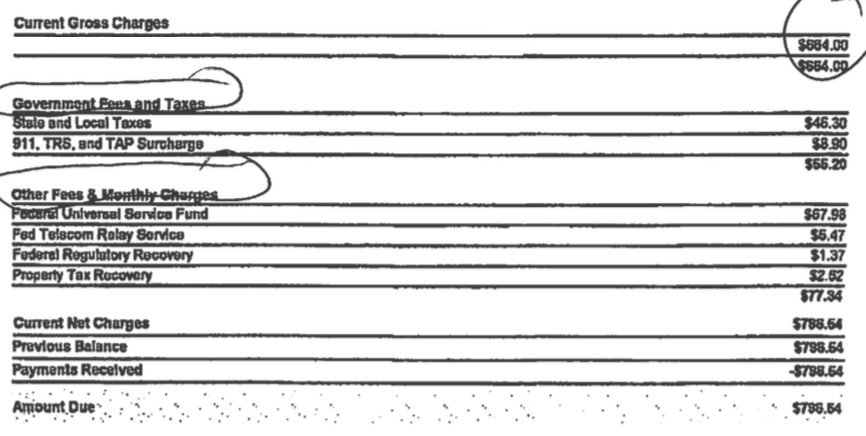
In this example, you can see the total bill is more than $100 higher than the contracted amount because the taxes came in at $55+ and other fees came in at $77+. While this unexpected spike should raise a red flag, this is pretty common.
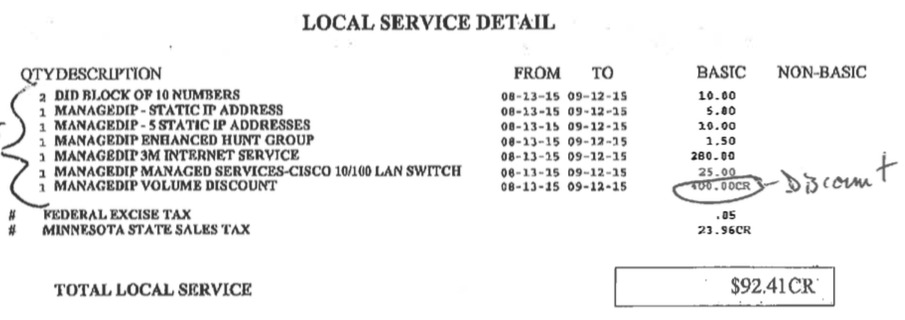
While your attention is on your bill, look for the discount you were promised in your proposal.
1. Discount Application
Most telecom carriers offer significant discounts, especially to first-time buyers, to make their prices seem low. When you get your bill, make sure your discount is applied – and applied correctly. This is especially important in the very beginning, because typically, once it’s applied, it doesn't change.
2. Total Amount Due
This is usually the easiest error to catch because you expect to pay roughly the same amount every month. As you’ll see in this example, the previous balance was $1,120, and this month’s balance is $558. Your immediate thought should be, why is there a difference?
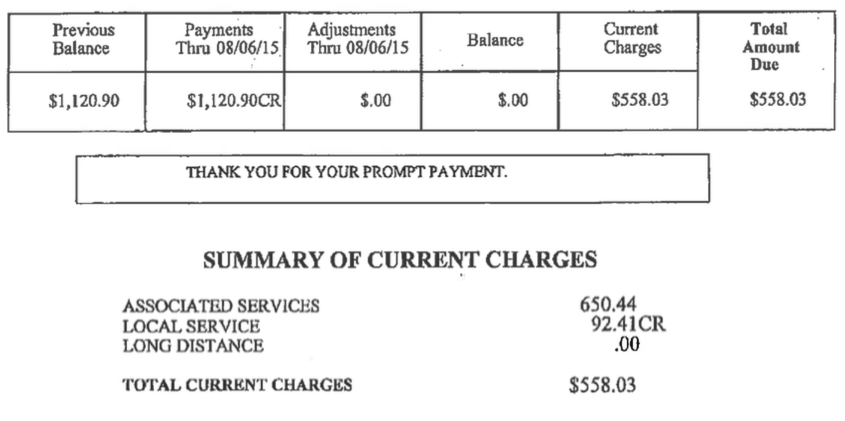
My guess is that this business paid their bill late, so they had to pay two months plus any late fees. But if that’s not the case, you’ll need to inquire about the drastic spike the month before.
3. Package Deals – Complex Line Items
Many telecom carriers make their bills complex intentionally. And, unfortunately, it works. Most companies don’t take the time to review their telecom services bill for that very reason. Here’s a prime example:
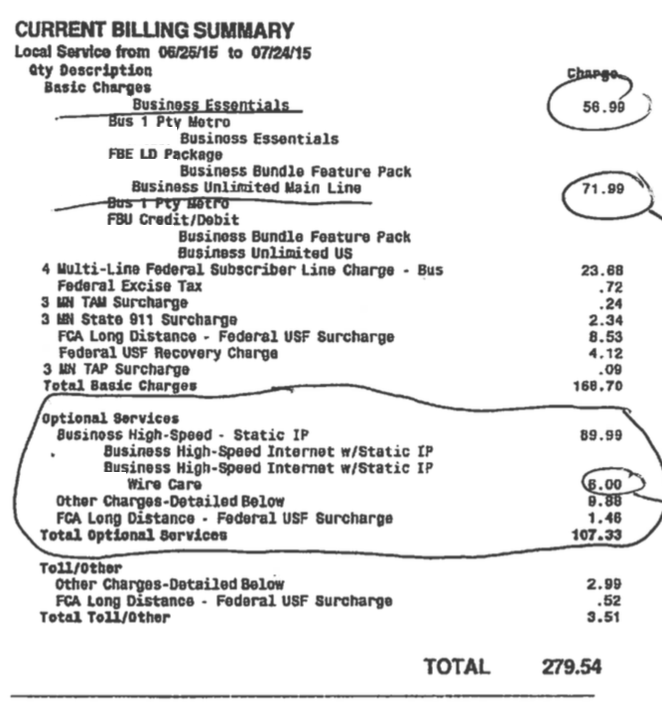
My question to this business would be – did you know you have two different phone lines? Do you know what the difference is?
In this case, the difference is that one line is unlimited long distance and the other is not. So on one phone line you get charged for long-distance, and on the other you don’t. I have to ask – did you know that your phone lines were set up this way? And are you using them accordingly?
A side note on long-distance calls, while we are on the subject... You’ll never see on your bill what you get charged per minute. You have to do the calculation – and to make it even trickier, and likely discourage you altogether, every carrier charges at different increments; you could be billed at 30, 18 or 6 seconds, or they might charge one fee for the initial 18 seconds and a different one for every 6 seconds thereafter. The combinations are endless. This fact is also not listed on your bill – you’ll likely have to dig through your contract to find this information.
4. Lump Sum
While this may be refreshing to see after the previous example – this over-simplified bill is equally helpless.
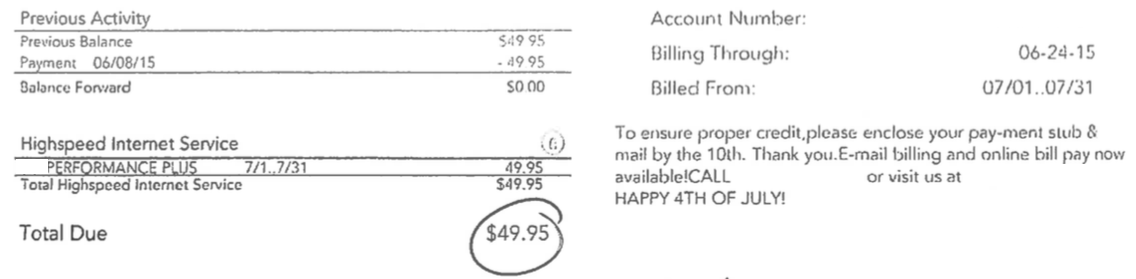
So, the Internet is $49.95, but what is this organization actually paying for? What speed? How much? What does PERFORMANCE PLUS mean? 20MB… 50MB… 100MB?
If the complex bills are unreadable and the simple bills are useless, what is there to do? In terms of telecommunication bills, it’s hard to win without the help of someone who can “speak the language.” If the rep that sold you services doesn’t seem to care about you past the initial sale, their job is likely to sell services, not make sure you are satisfied. Especially if they’ve got you locked in for at least 36 months.
The best way to make sure you order what you need, get what you pay for, and have someone available to call with questions or discrepancies on your bill (throughout the entire contract) is through a telecom consultant. If you are interested, take a moment to compare telecom consulting services with your current carriers.