Sourcewell Cooperative Contracts Vs. RFPs: Process Comparison [Infographic]

Sourcewell Cooperative Contracts Vs. RFPs: Process Comparison [Infographic]

The budget year is coming to an end, and your business needs to upgrade its telecommunication systems. There are two choices when it comes to making a purchase: the standard Request for Proposal (RFP) process or a cooperative contract from Sourcewell. What are the differences between the two? More importantly, which one is better for your government agency, school district or non-profit?
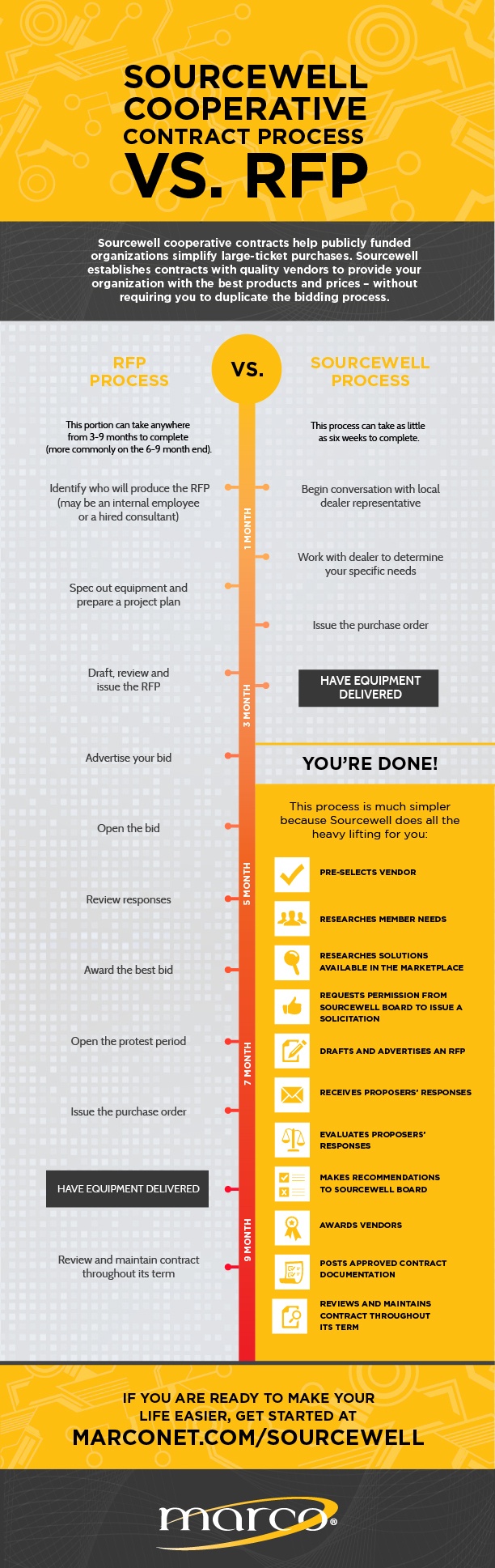
Marco-Sourcewell-Comparison-Infographic-11-01-18

RFPs

Submitting a request for proposal is a process that, for better or worse, has been essential for updating and upgrading technology in the office. The process starts as you identify manufacturers and providers that could provide suitable equipment.

Next, you devote significant time to defining your RFP requirements, specifying equipment needs and advertising your competitive solicitations through the RFP process. Next, you collect and compare them. Many times, RFP responses are either low cost and low quality or high quality and high cost.

If your options don't fit your needs and/or your budget, it can mean scrapping the project and waiting another year before starting the RFP process over again or settling for a solution that isn't quite right. 

The average RFP process lasts anywhere from three to nine months. In reality, most government agencies and nonprofits find that the RFP process takes six to nine months - or longer. Fortunately, there's a better way.

Cooperative Contracts

Sourcewell has spent years building a nationwide network of vendors and providers that are preselected for excellent service and first-rate telecommunication products. The aim of Sourcewell is to make it easier for government agencies, school districts and nonprofits to secure the technology, products and services they need. 

In order to benefit from Sourcewell cooperative contracts, all you need to do is become an Sourcewell member. After that simple step, you can begin a conversation with local dealer representatives by outlining the services and features your office requires and issue a purchase order that features terms and conditions you'd like to include.

Sourcewell has already taken care of the legwork. Their network of preselected vendors is carefully selected to meet the needs of its members, and the RFP process is completed in advance. By the time you see a competitive solicitation from an Sourcewell provider, it has already been evaluated and approved. Sourcewell works with providers like Mitel to ensure its members have access to the best solutions possible at an affordable price.

All you need to do is cut a PO after reviewing competitive solicitations, and wait for the equipment to be delivered. Your local dealer representative will work with you to install your equipment and train your staff. How much time does this take? You'll have new equipment in your office in as little as six weeks. It's that simple.

Learn More About Sourcewell Benefits Contact a Marco Rep 

Related Posts

What Is Wi-Fi 7 and Does Your Business Need It?

Wi-Fi 7 is the latest wireless networking standard, and for most businesses, it's not an urgent upgrade — yet. Whether it belongs on your radar right now depends on the age of your...

The Top Practical Applications of IoT in Manufacturing

Back in 2019, 86% of survey respondents said they believed smart factory initiatives would be the main driver of manufacturing competitiveness in the next 5 years. However, accordi...

How M-Files and Microsoft Make Content AI-Ready

Many organizations have spent years investing in the Microsoft ecosystem — Microsoft 365, SharePoint, Teams, and now Copilot. The tools are powerful. The data is abundant. But as A...

When Is Managed IT the Right Fit for Your Business?

Organizations have three options when it comes to managing their technology. They can handle all of their IT needs internally, they can outsource some IT work — like cybersecurity ...

Microsoft 365 Pricing Changes in 2026

Microsoft has announced broad pricing changes to Microsoft 365 that take effect July 1, 2026. That might sound far away, but most organizations will have to start making important ...

Cloud-First IT Strategy: What It Really Means and How to Execute It

“Cloud-first” is one of those IT phrases that sounds straightforward — until you try to execute it. Some organizations treat it like a strict directive: move everything to the clou...

Cybersecurity Compliance Requirements for Financial Services: A Simplified Checklist

If you're reading this, you're probably already drowning in compliance requirements. Maybe you're trying to figure out which regulations actually apply to your organization. Or you...

Navigating VMware Licensing Changes: What You Need to Know Now

Two years after Broadcom completed its $69 billion acquisition of VMware in November 2023, the licensing overhaul that many hoped might soften over time has instead become the new ...

What To Know About the 2026 Memory Chip Shortage

Still need to update some Windows 10 hardware or buy new servers? Our best advice is to make those purchases ASAP. Manufacturers from Cisco to HP are sounding the alarm about a com...

New Cisco Smart Switches: AI-Ready Networking for SMBs

The way we work is changing fast. From video conferences that feel like you're in the same room to AI tools that help streamline operations, technology is pushing business networks...