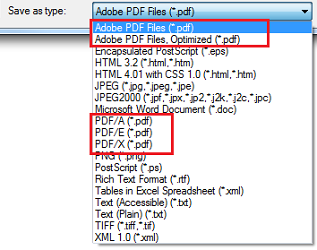
Many people are familiar with PDF files; you’ve probably accessed a PDF recently or even created one. PDF stands for Portable Document Format; it was created by Adobe so users could easily share a document regardless of what software, hardware, or operating systems the recipient may be using.
Since Adobe developed the original PDF in 1993, they’ve also created different subcategories of this popular format, which are commonly referred to as PDF standards. Each standard serves a different purpose, so if you save your file as the wrong standard, you may experience issues when trying to print, share or archive files, now or in the future.
Understanding PDF Standards
There are a total of eight PDF standards; six are ISO Standards, and two are from other organizations.
Six Types of PDF Standards From ISO
ISO stands for International Standards Organization, which issues certifications for products that meet their standards across many industries, PDF documents included. The ISO sets standards based on a rigorous certification process to assure quality, reliability, and universality. The best PDF standard for your document depends on how you intend to store, share, and use it.
PDF –This general PDF standard is sufficient for in-office use, sharing, and viewing online and for standard quality documents. While the original PDF was created almost 30 years ago, Adobe released PDF 2.0 in 2017.
- PDF – This standard was developed for long-term file storage, commonly used by archivists, records managers and compliance managers. It has a restricted set of features, including JavaScript, audio and video content and encryption, because they may disallow users from opening and viewing accurately in the future.
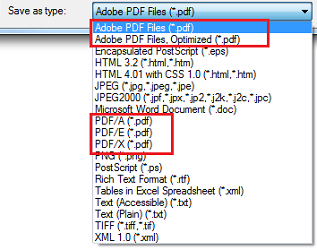
- PDF/A – This standard was developed for long-term file storage, commonly used by archivists, records managers, and compliance managers. It has a restricted set of features, including JavaScript, audio and video content, and encryption, because they may disallow users from opening and viewing accurately in the future.
- PDF/E – Available as of 2008, architects, engineers, construction professionals, and manufacturing product teams will use this standard most often as it helps rotate and fold 3D objects on-screen.
- PDF/X – This standard best suits print professionals, graphic designers, and creative professionals who need to create high-quality, professional-grade documents. This PDF standard will ensure print-ready documents by correctly embedding fonts, images, color profiles, and more. Newer versions of this standard enable more automation throughout the pre-press, press, and post-press processes.
- PDF/UA – This standard enhances readability for people with disabilities and is often required to provide Unrestricted Access (UA) to digital information. This standard is compatible with assistive technology that assists users through reading and navigation.
- PDF/VT – Print professionals will also use this standard for documents, which is based on components of the PDF/X standard. It maintains color profiles, layers, and transparency in documents and can customize data, making it useful for printing bank statements, invoices, and personalized marketing material.
Two Types of PDF Standards From Other Organizations
Additional organizations have adopted standards for their specific document needs.
- PAdES – PAdES stands for PDF Advanced Electronic Signatures, which is a set of standards published by ETSI to comply with European Union requirements.
- PDF Healthcare –This standard, created by Adobe Acrobat, provides best practices and implementation guidelines to capture, exchange, preserve and protect healthcare information. This standard is compatible with personal documents, XML data, DICOM images and data, clinical notes, lab reports, electronic forms, scanned images, photographs, digital X-rays, and ECGs.
Preserving and Securing Your Data
If your organization would like to improve its Enterprise Content Management so you can better secure and access your valuable data, understanding various PDF options can be extremely helpful. However, for more information on how you can derive the most benefit from your organization’s data, feel free to connect with a Marco Enterprise Content Management specialist.